

#AEO
AEO vs. SEO: What's the Difference? (And Do You Need Both?)
AEO gets your brand cited inside AI-generated answers. SEO gets it ranked in a list. The gap between those two outcomes is widening — and most brands are only doing one of them.
Answer Engine Optimization (AEO) is the practice of structuring content so AI systems — including ChatGPT, Perplexity, Google AI Overviews, and other LLMs — can extract, understand, and cite your brand in generated answers.

The first sales call for many B2B buyers now happens inside an AI-generated answer — before they ever visit your website.
A prospective customer asks ChatGPT which project management tool fits their team. They ask Perplexity to compare CRM options for their industry. They type a question into Google and an AI Overview answers it directly, with citations. By the time they click through to your website — if they click at all — they've already been recommended a shortlist. And if you're not on it, you don't exist in their consideration set.
Most brands are invisible in those answers. Not because their content is bad, but because it wasn't built for this.
Answer Engine Optimization (AEO) is the practice of structuring content so AI systems — including ChatGPT, Perplexity, Google AI Overviews, and other LLMs — can extract, understand, and cite your brand in generated answers.
If you don't appear in AI answers for the questions your buyers are asking, your competitors will.
AEO stands for Answer Engine Optimization. The term distinguishes a new set of practices from traditional search engine optimization by naming exactly what's different: the engine being optimized for isn't a search engine that returns a list of links — it's an answer engine that generates a direct response.
"Answer engines" are AI systems that synthesize information into direct answers rather than returning ten blue links. ChatGPT, Perplexity, Claude, and Google AI Overviews all function as answer engines, though they work differently under the hood. When someone asks a question, these systems retrieve relevant web content, process it, and deliver a synthesized answer — often citing specific sources.
The distinction from traditional SEO is fundamental. SEO optimizes for a ranking in a list. AEO optimizes for inclusion in the answer itself. In SEO, you compete for position. In AEO, you compete to be the source an AI quotes, references, or recommends.
As HubSpot's AI search visibility playbook (January 2026) puts it, citation behavior is emerging as the key indicator of trust and authority — traditional SEO strength like rankings and backlinks showed little correlation with brand mentions in AI answers. As Ahrefs has noted, GEO (Generative Engine Optimization), LLMO (Large Language Model Optimization), and AEO are effectively three names for the same strategic shift — with over 90% overlap in tactics across all three approaches.
The practical implication is straightforward. Webflow's growth team has reported that traffic referred from ChatGPT converts at 24% — six times higher than their non-branded organic search conversion rate of 4% (Growth Unhinged, November 2025). The reader arriving from an AI citation has already been pre-qualified by the conversation they had with the AI. They're not browsing; they're evaluating.
The core distinction between SEO and AEO is this: SEO gets you ranked. AEO gets you cited.
In SEO, you compete for a position in the blue links — the ten organic results Google returns for a query. Success means appearing on page one, ideally in the top three. In AEO, you compete to be the source an AI system quotes as part of its generated answer. There is no "position one" in an AI-generated response in the same way. Instead, there's being included — or not.
What AI engines optimize for differs from what Google's traditional algorithm optimizes for. Google weighs backlinks, domain authority, and on-page relevance heavily. AI answer engines weight different signals: content clarity and structure, factual accuracy, E-E-A-T signals (Experience, Expertise, Authoritativeness, Trustworthiness), recency, and whether content is formatted in a way that's easy for a model to extract and synthesize.
Research from The Digital Bloom's 2025 AI Visibility Report, examining 7,000+ citations across 1,600 URLs, found that brand search volume — with a correlation of 0.334 — is the strongest predictor of AI citations, while backlinks show weak or neutral correlation. SearchAtlas's 2025 analysis reinforces this: 95% of citation behavior is unexplained by traffic metrics and 97.2% by backlink profiles. This is a significant departure from traditional SEO, where backlinks have historically been among the most important ranking factors.
Meanwhile, the "zero-click" trend is accelerating. By mid-2025, approximately 65% of Google searches ended without a click to any website, up from 58.5% in mid-2024 (Onely, December 2025; Similarweb, 2025). When AI Overviews appear, the zero-click rate climbs to 83% on average (Click Vision/Similarweb, 2025). AI Overviews now reduce clicks by 58% according to Ahrefs' February 2026 analysis, and Pew Research Center data shows only 8% of users click through when an AI Overview is present, compared to 15% without one.
This is what some practitioners call the "crocodile mouth" effect: impressions are rising as AI Overviews expand, but clicks are falling. AEO is how you stay visible when the answer is the destination.
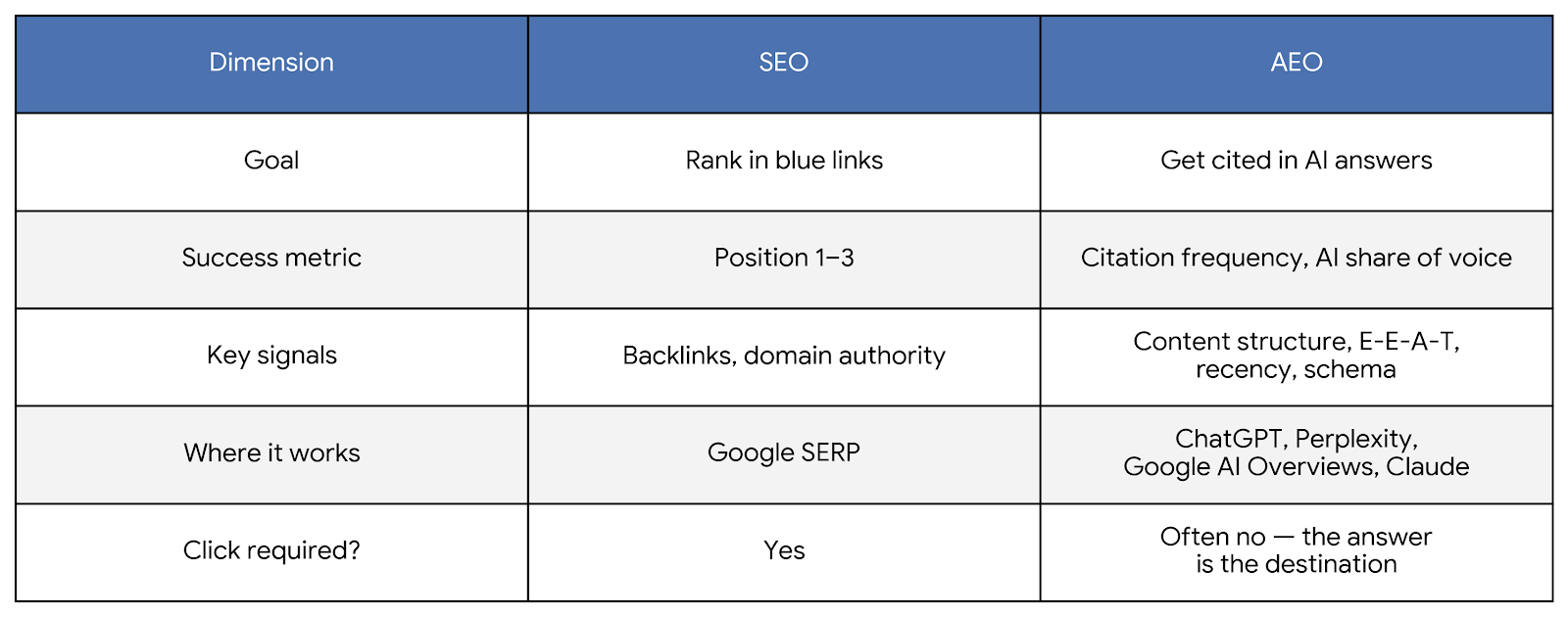
One critical nuance: SEO and AEO are not either/or. Approximately 80% of the optimization effort — creating quality content, building topical authority, establishing E-E-A-T signals, maintaining freshness — serves both systems. The 20% divergence is where competitive advantage lives. SEO-specific tactics like backlink building and meta tag optimization don't directly drive LLM citations. AEO-specific tactics like extractable Q&A structure, entity definitions, and comparison tables don't directly impact Google rankings. The brands that win are the ones layering AEO on top of a strong SEO foundation.
The data makes the case.
ChatGPT reached 800 million weekly active users as of October 2025, doubling from 400 million earlier that year (TechCrunch, October 2025). It dominates AI referral traffic at 77–87% of all AI platform referrals, according to SE Ranking and Conductor's 2025 research. Perplexity holds roughly 15% globally and is growing rapidly. Google AI Overviews now appear on an estimated 13–20% of queries and are expanding (Semrush/BrightEdge, 2025).
Yet the correlation between traditional Google rankings and AI citations is weaker than most marketers assume. Ahrefs' August 2025 research found that only 12% of AI-cited URLs appear in Google's top 10 organic results for the same queries. For ChatGPT specifically, Seer Interactive found just 8% overlap with Google's top 10. This means domain authority and traditional rankings alone are not enough to guarantee AI visibility.
The freshness signal is also significant. AI platforms consistently favor recently updated content. SE Ranking's analysis found that content updated within the last 30 days receives 3.2x more citations than content older than 90 days. Ahrefs' analysis of ChatGPT's most-cited pages found that 60.5% of those with detectable publication dates were published within the last two years, and the platform shows a measurable recency bias.
For B2B brands, the competitive implications are immediate. When a prospective buyer asks ChatGPT to recommend vendors in your category, the AI synthesizes an answer from the sources it can find and trust. If your content isn't structured to be cited, your competitors will be recommended instead. AI traffic to Webflow now accounts for 10% of their total signups, with two-thirds of those AI-referred users converting within seven days (Growth Unhinged, November 2025).
Google still sends roughly 300x more traffic than all AI platforms combined — organic search drove 48.5% of internet traffic in 2025, while AI platforms drove 0.15% (SE Ranking, 2025). But the growth trajectory is exponential. Adobe Digital Insights reports AI referral traffic increased 12–15x from July 2024 to February 2025, and AI traffic grew 7x year-over-year from 0.02% to 0.15% of all internet traffic (SE Ranking, September 2025). The window to establish citation authority before the market catches up is narrowing. As Backlinko has identified, there's roughly a 6–12 month window for companies to establish AI visibility authority before competition intensifies.
AEO isn't one tactic. It's a system with four interdependent layers. Here's how each works.
AI models extract answers that are clearly stated, self-contained, and lead with the conclusion. This is fundamentally different from the narrative "ultimate guide" format that dominated SEO content for years.
Kevin Indig's analysis of 1.2 million ChatGPT answers and 18,012 verified citations (Growth Memo, February 2026) found that 44.2% of all ChatGPT citations come from the first 30% of content on a page. LLMs are trained on journalism and academic writing that follows a "bottom line up front" structure — and they inherit that preference when selecting what to cite.
The practical implications are specific. Put the direct answer in the first 40–60 words of every section — this is the optimal paragraph length for AI chunking, according to research compiled in the AEO/GEO Definitive Data Guide. Use question-based H2 and H3 headings that mirror how users prompt AI tools. Add FAQ schema sections, which LLMs parse directly. Structure content so each section can stand alone as an extractable "answer capsule" — a concise 120–150 character explanation placed directly after a question heading.
Princeton University's landmark GEO study (published at KDD 2024, analyzing 10,000 queries across 9 sources — findings subsequently validated by multiple 2025 industry studies) found that adding cited sources to content produced a 115.1% visibility increase for rank #5 sites, adding quotations improved visibility by 37%, and adding statistics boosted visibility by 22%. Critically, keyword stuffing showed negative impact — the opposite of its historical SEO effect. The Digital Bloom's 2025 AI Visibility Report confirmed these findings at scale, noting that GEO-style optimization increases LLM visibility by 30–40%.
Experience, Expertise, Authoritativeness, and Trustworthiness. Google coined the E-E-A-T framework for its quality rater guidelines, but AI answer engines have adopted similar credibility heuristics — especially Google AI Overviews, which explicitly filter on E-E-A-T as stage three of its five-stage citation pipeline.
What this means in practice: author bylines with credentials matter. Cited data sources with clear attribution matter. Accurate publication and update dates matter. Every factual claim benefits from having a source. AI models reward citation density — content that attributes its claims is more likely to be cited itself.
The rule is simple: if a model can't quote your content and verify the underlying claim, it's less likely to cite it. Content that reads as authoritative but provides no evidence for its assertions loses to content that shows its work.
AI crawlers — GPTBot (OpenAI), ClaudeBot (Anthropic), PerplexityBot — must be able to access your content. The first step in any AEO audit is checking your robots.txt file to ensure you haven't inadvertently blocked these crawlers.
Schema markup helps AI systems understand your content structure. Article schema, FAQ schema, HowTo schema, and Speakable schema all provide machine-readable context that improves extraction. Research compiled by Webflow's AEO assessment indicates that 73% of websites cited by Google on the top page have schema markup, while 88% of websites lack schema entirely — suggesting significant low-hanging fruit.
Page speed matters too, and perhaps more than most marketers realize. SE Ranking's November 2025 analysis found that pages with First Contentful Paint (FCP) under 0.4 seconds average 6.7 ChatGPT citations, while slower pages (over 1.13 seconds) drop to just 2.1. Many AI systems impose tight timeouts of 1–5 seconds when retrieving content, meaning slow or JavaScript-heavy pages risk being dropped entirely.
This may be the most underappreciated pillar. AirOps' research across 500+ commercial-intent queries found that 85% of brand mentions in AI responses come from third-party sources — external domains like review sites, publications, and forums — rather than the brand's own website. Brands are 6.5x more likely to be cited through third-party sources than their own domains.
Reddit threads, YouTube transcripts, press mentions, and podcast appearances all feed the AI's understanding of who you are. For Perplexity specifically, Reddit dominates as a citation source, with YouTube close behind (Ahrefs, June 2025). Across AI platforms more broadly, the top cited domains in ChatGPT in the US are Reddit, Wikipedia, Amazon, Forbes, and Business Insider (Ahrefs, September 2025). The platform's design means it won't generate answers if no reputable sources are found — making third-party presence critical.
Community platforms like G2, Capterra, and Quora contribute to how AI models understand your brand in context. Digital PR and earned media isn't just brand awareness anymore — it's AEO strategy. Sites with a presence on 4+ platforms are 2.8x more likely to appear in ChatGPT responses, according to research cited in the AEO/GEO Definitive Data Guide.
The terminology in this space is still settling, but working definitions have emerged.
AEO — Answer Engine Optimization — focuses on structuring content so it gets surfaced as direct answers in AI-generated responses. Think of it as the content strategy layer: how you write, format, and organize information so AI systems can extract and cite it.
GEO — Generative Engine Optimization — was formally coined by Princeton University researchers in November 2023. It describes the broader umbrella of optimizing presence across generative AI systems, including the more technical implementation layer.
In practice, the two terms are used almost interchangeably by most practitioners. As Ahrefs has noted, the practical overlap in tactics is 90%+ across AEO, GEO, and LLMO (Large Language Model Optimization). If a distinction is useful, think of AEO as the content strategy and GEO as the technical implementation — but don't lose sleep over the taxonomy. The work is the same.
For a deeper breakdown, see our guide to What is Generative Engine Optimization (GEO)?
The difference between a page that gets cited and one that doesn't often comes down to structure, not quality. Here's what changes when you optimize a page for AEO.
Before (typical SEO blog post): A standard blog intro that builds to the point over three paragraphs. General claims without specific data. No schema markup. H2 headings are topical labels ("The Importance of X") rather than questions. No FAQ section. The "last updated" date is buried or absent. The direct answer to the reader's question doesn't appear until paragraph four.
After (AEO-optimized): The direct answer appears in the first 40–60 words — the "answer capsule." H2 headings are framed as questions that mirror how users prompt AI tools ("How does X work?" rather than "Understanding X"). Every factual claim includes a source with attribution. FAQ schema is implemented with 4–6 questions that address related queries. The "last updated" date is prominent and accurate. Comparison tables use proper `<thead>` markup — pages with comparison tables achieve 47% higher AI citation rates. The page can be chunked into self-contained sections, each of which independently answers a specific question.
The shift is less about writing new content and more about restructuring existing content so AI systems can parse it. Your 5,000-word guide might rank #1 on Google but offer no clear "quotable" answer for an AI model. A competitor's 1,500-word page with clear Q&A structure gets cited instead.
This is the minimum viable AEO implementation. Each step builds on the last.
1. Audit your robots.txt. Are you blocking AI crawlers? Check for GPTBot, ClaudeBot, and PerplexityBot. If they're blocked, AI systems literally cannot access your content. This is the most common — and most easily fixed — AEO issue.
2. Rewrite your top 10 pages with answer-first structure. For each page, identify the primary question it answers. Put the direct answer in the first paragraph — not the third, not the fourth. Use question-based headings. Add comparison tables where relevant. Target the pages that already have strong SEO performance, since AI is more likely to cite content that already has authority signals.
3. Add FAQ schema to every blog post and key landing page. FAQ schema gives AI systems machine-readable Q&A pairs to extract. This is one of the highest-leverage, lowest-effort AEO implementations available. Webflow reported adding FAQ schema to six of their biggest feature pages, each mirroring how people naturally ask questions about those topics.
4. Start tracking your AI visibility. You can't optimize what you can't measure. Run your top 10 buyer-intent queries through ChatGPT, Perplexity, and Google. Document which competitors appear, what sources get cited, and whether your brand appears at all. This gives you a baseline "share of AI voice." AI search visibility tools like CheckThat can automate this monitoring across platforms.
5. Build off-site authority. Identify three platforms where your ideal customers ask questions — Reddit, G2, YouTube, Quora, industry forums — and start contributing authentically. Remember: 85% of brand mentions in AI come from third-party sources (AirOps, 2025). Your own website is necessary but not sufficient.
Want to see how your brand currently appears in AI search?
Every week, we share real examples and systems the fastest-growing companies are using to scale smarter.
Get the last workshop recording when you sign up.
AEO gets your brand cited inside AI-generated answers. SEO gets it ranked in a list. The gap between those two outcomes is widening — and most brands are only doing one of them.

ChatGPT prompts for marketing that stay specific. Fifteen frameworks for personas, positioning, content, outreach, and experiments.

Context artifacts are reusable documents that give AI everything it needs to produce consistent, on-brand output — every time you start a new session. Here's the four-artifact system that separates production-grade AI content from generic output.