

#AEO
AEO vs. SEO: What's the Difference? (And Do You Need Both?)
AEO gets your brand cited inside AI-generated answers. SEO gets it ranked in a list. The gap between those two outcomes is widening — and most brands are only doing one of them.
Context artifacts are reusable documents that give AI everything it needs to produce consistent, on-brand output — every time you start a new session. Here's the four-artifact system that separates production-grade AI content from generic output.

You know the experience. You write a detailed prompt. The first draft comes back decent — maybe even good. You refine it over a few messages. By message 15 or 20, the output sounds like a completely different (and noticeably worse) AI wrote it.
Context artifacts are the fix — reusable documents that live outside any single conversation and give the AI everything it needs to produce consistent, on-brand output every time you start a new session.
Research published by Chroma in July 2025 demonstrated that LLM performance degrades systematically as input context length increases — a phenomenon they call "context rot." In their evaluation of 18 leading models including GPT-4.1, Claude 4, and Gemini 2.5, they found that providing a model with full conversation history (approximately 113,000 tokens) dropped accuracy by roughly 30% compared to providing only the relevant excerpt (around 300 tokens). The model doesn't tell you when it's lost the thread. It just starts producing worse work.
This matters especially if you're producing content for answer engines — where the quality and extractability of every piece determines whether your brand gets cited or ignored.
The implication is straightforward: every long prompt conversation assumes the AI remembers what you told it earlier. It doesn't. And the longer the conversation runs, the worse this gets.
Prompts are ephemeral. They exist inside a single chat window and disappear after that session. For quick, one-off tasks, that's fine. But for content production at any real volume, this breaks in three specific ways.
First, context drift. As Chroma's research confirms, model performance declines as the conversation grows longer. Your carefully written instructions from message three get effectively pushed out of the model's working attention by message fifteen. The AI doesn't flag this — it just quietly starts defaulting to its most generic patterns.
Second, vague instructions. Telling an AI to "be conversational" or "write like us" gives it almost nothing to work with. "Conversational" has dozens of interpretations in the model's training data, and none of them are specific to your brand. The result is the model's best statistical guess at what "conversational" means — which is the same guess it gives everyone else. One practitioner at a B2B SaaS company kept prompting for "more conversational" output. By the fifteenth exchange, the AI was inserting "howdy" and "y'all" into enterprise content. The AI wasn't broken — "conversational" simply meant something different to the model than it did to the writer.
Third, no version control. If your positioning changes — new ICP, new messaging pillars, updated competitive landscape — you have to re-explain everything from scratch in every new conversation. Nothing carries over. Nothing compounds.
The fix isn't a more elaborate prompt. It's context that persists outside the conversation.
A context artifact is a persistent, version-controlled document containing the information an AI needs to produce consistent, brand-accurate output — independent of any single conversation.
Think of it as a brief for a new hire, except this hire processes information at extraordinary speed and has zero memory between sessions. Without the brief, every session starts from absolute zero. With the brief, the AI starts from a baseline that already reflects your brand, your product, and your audience.
The distinction between artifacts and guidelines is important. A guideline says: "Be conversational but professional." An artifact says: "Use contractions. Start roughly 30% of sentences with 'And,' 'But,' or 'So.' Never use 'leverage,' 'utilize,' or 'solutions.' Lead with what the thing does before explaining how it works."
The guideline describes a vibe. The artifact models a pattern the AI can actually follow.
This is why context engineering — the practice of building and maintaining these structured inputs — is emerging as a discipline distinct from prompt engineering. As the Chroma researchers wrote in their July 2025 report, their results highlight "the importance of context engineering" over simply expanding context windows or refining individual prompts. The same conclusion is showing up across the industry: Contentstack, Jasper, and multiple practitioner communities have all moved toward treating context curation as a core operational capability rather than a nice-to-have.
When you build context artifacts instead of chasing perfect prompts, you stop wrestling with individual outputs and start directing a system. One artifact update propagates across every workflow that references it.
At AI-Led Growth, the context engineering process — what we call building a "the 4 artifacts" — is the foundation of every client engagement. The pack includes four types of context: company profile, voice guidelines, audience persona, and customer voice-of-customer data. Here's what each one does and why it matters.
This artifact anchors every piece of content in factual accuracy. It prevents the AI from hallucinating product features, misrepresenting your value proposition, or writing generic copy that could apply to a hundred different companies.
Without it, the AI invents. It'll describe features you don't have, position you against competitors you don't actually compete with, and default to bland phrases like "comprehensive solutions" that say nothing about your actual differentiation.
With it, every piece of content references accurate product details, speaks to real competitive positioning, and aligns with your go-to-market strategy.
What to include: a clear product description (what it does, for whom, how it's different from alternatives), your key positioning statements, ICP definition, a competitor list with how you differ from each, and your current messaging pillars.
The compounding benefit is significant. When positioning changes — and it will — you update one document instead of re-explaining your company in three hundred separate conversations. At AI-Led Growth, this artifact gets built in week one of every client engagement. As Marcel Santilli, CEO of GrowthX, has described in multiple workshops, the 4 artifacts is the foundation that determines whether the content system produces differentiated work or generic filler. Getting the inputs right is the primary focus of the first four weeks with any new brand — because everything downstream depends on it.
This artifact makes output recognizable as yours. It defines sentence structure, vocabulary, punctuation conventions, and tone — not as abstract descriptions, but as concrete patterns.
Without it, output defaults to what AI practitioners call "corporate median" — the safe, generic style that emerges from averaging across millions of training examples. Your content sounds like everyone else's content because the AI is literally producing the statistical center of all the writing it's trained on. The GrowthX team maintains an internal document called "AI Red Flags to Avoid" that catalogs these patterns: em-dash overuse, dependent clause constructions like "By implementing these strategies," hedging language like "can," "might," "arguably," and business buzzwords like "landscape," "delve," "robust," and "comprehensive." These aren't just AI tells — they're writing weaknesses that AI amplifies because they appear so frequently in its training data.
With a voice artifact, output matches your specific tone — whether that's blunt and tactical, warm and approachable, or data-driven and direct.
What to include: sentence structure patterns (do you lead with data or story?), vocabulary rules (words you use, words you never use), punctuation conventions, and most importantly — examples of good versus bad output placed side by side.
Here's how to build this without starting from scratch: take two versions of the same piece — your rough draft and the polished final version. Give both to the AI with this prompt: "Create writing guidelines based on the changes between these two versions." The output is a style guide grounded in real editorial decisions, not abstractions.
One important nuance: telling the AI "don't use em-dashes" often backfires — it replaces them with colons or semicolons and introduces a different problem. You have to model the structure you want, not just list what to avoid.
This artifact forces content to speak to the specific context your audience lives in — their frustrations, the solutions they've already tried and abandoned, the language they actually use to describe their problems.
Without it, content addresses "marketing leaders" or "growth teams" in vague generalities that could apply to anyone. With it, content feels like a direct conversation with someone who understands the reader's exact situation.
What to include: job title and reporting structure, primary pain points ranked by intensity, what they've already tried that failed, what they're actively searching for, and the specific language they use to describe their challenges.
The difference in output is stark. Without the persona artifact, you get headlines like "Get more from your content marketing." With it, you get "Ship 12 articles a week without adding headcount." The specificity comes from the artifact, not from the prompt.
AI-Led Growth builds detailed ICP profiles for every client, broken down by tier — executive-level decision makers and day-to-day operators have fundamentally different pain points, fears, and buying triggers. The executive might fear brand voice dilution and wasted agency spend. The operator might fear becoming the "AI editor" — spending more time fixing AI output than they'd spend writing from scratch. Both are real concerns drawn from actual customer research, and the content that addresses each one needs different framing, different examples, and different proof points.
This artifact injects the exact language your customers use to describe problems, benefits, and outcomes. It's the difference between content that sounds like marketing and content that sounds like validation.
Without it, content uses your internal marketing language — the way your team talks about the product. With it, content reflects what customers already believe and the words they already use. You're not selling. You're confirming.
What to include: direct quotes from customer interviews, relevant excerpts from sales call transcripts, review language from G2 or Capterra, patterns from support tickets, and comments from social posts where prospects describe their challenges.
The conversion effect is real: when a prospect reads an article that describes their exact situation in their exact language, the mental shift from "this is marketing" to "these people understand my problem" happens almost immediately. That shift is what drives the next click.
The artifacts don't work in isolation. Different phases of content production lean on different artifacts, and the strongest output comes from layering them.
In the research phase, you're pulling from the Company Profile and Audience Persona. Tone doesn't matter yet — you're gathering facts and establishing context. What does the product actually do? Who specifically is this piece for? What problem are we addressing?
In the outline phase, all four artifacts work together. The structure needs to reflect your audience's priorities (Persona), your product's actual positioning (Company Profile), the tone your brand uses (Voice Guidelines), and the language your buyers use to describe the problem (Customer Quotes).
In the drafting phase, Voice Guidelines and Customer Quotes carry the heaviest weight. This is where sentence patterns, vocabulary choices, and buyer language shape every paragraph.
In the polish phase, Voice Guidelines act as the final filter. Every sentence gets checked against the patterns you've defined — not against a vague sense of "does this sound right?" Once the content is solid, you'll want to track how it performs in AI answers — the best AI search visibility tools give you that ongoing feedback loop.
The key insight: you're not using artifacts to replace editorial judgment. You're using them to persist it. The judgment is yours. The artifact is how you scale it across dozens or hundreds of pieces without that judgment degrading over time.
As described in the AI-Led Growth cohort curriculum, the production process isn't a linear pipeline — it's a loop. Each draft gets evaluated against the artifacts for groundedness, voice adherence, and directional accuracy. Then it gets refined. Then it gets evaluated again. The artifacts are what make this loop possible without requiring a senior editor to hold everything in their head.
Prompt engineering optimizes the input to a single conversation. Context engineering builds the infrastructure that makes every conversation start from a higher baseline.
Both matter. But in the wrong order, better prompts actually make things worse. Teams obsess over crafting the perfect prompt before they've defined what good output even looks like. The result: marginal improvements on a fundamentally flawed foundation.
The order matters: build context first, then prompt.
The analogy is simple. You wouldn't hire a writer without giving them a brief, a style guide, and an understanding of your product. Don't treat AI differently. The brief is your artifact. The prompt is the assignment. Without the brief, even a perfectly worded assignment produces generic work.
This is the shift that Chroma's research underscores. Their key finding wasn't just that performance degrades with longer contexts — it was that curated, focused context dramatically outperforms raw context dumps. The models they tested performed significantly better when given only the relevant information rather than the full conversational history. Context engineering, in their framing, is about giving the model the right information, not more information.
The difference between artifact-powered content and prompt-only content shows up immediately in output quality.
Consider a generic prompt like "Write a blog post headline about AI content marketing for SaaS companies." A model without context artifacts will produce something like: "Transform Your Marketing Strategy with AI-Powered Content." It's technically correct. It's also completely interchangeable with a headline from any other company.
Now give that same model your Company Profile (Series B SaaS, specific ICP, defined positioning), your Audience Persona (VP Marketing at a scaling company, three-person content team, pressure to increase output without headcount), and your Voice Guidelines (lead with outcomes, be specific about numbers, skip the buzzwords). The output shifts to something like: "Ship Series C Content Volume on a Series B Budget Without Sacrificing Quality."
The prompt didn't change. The context did. And the output went from generic to targeted.
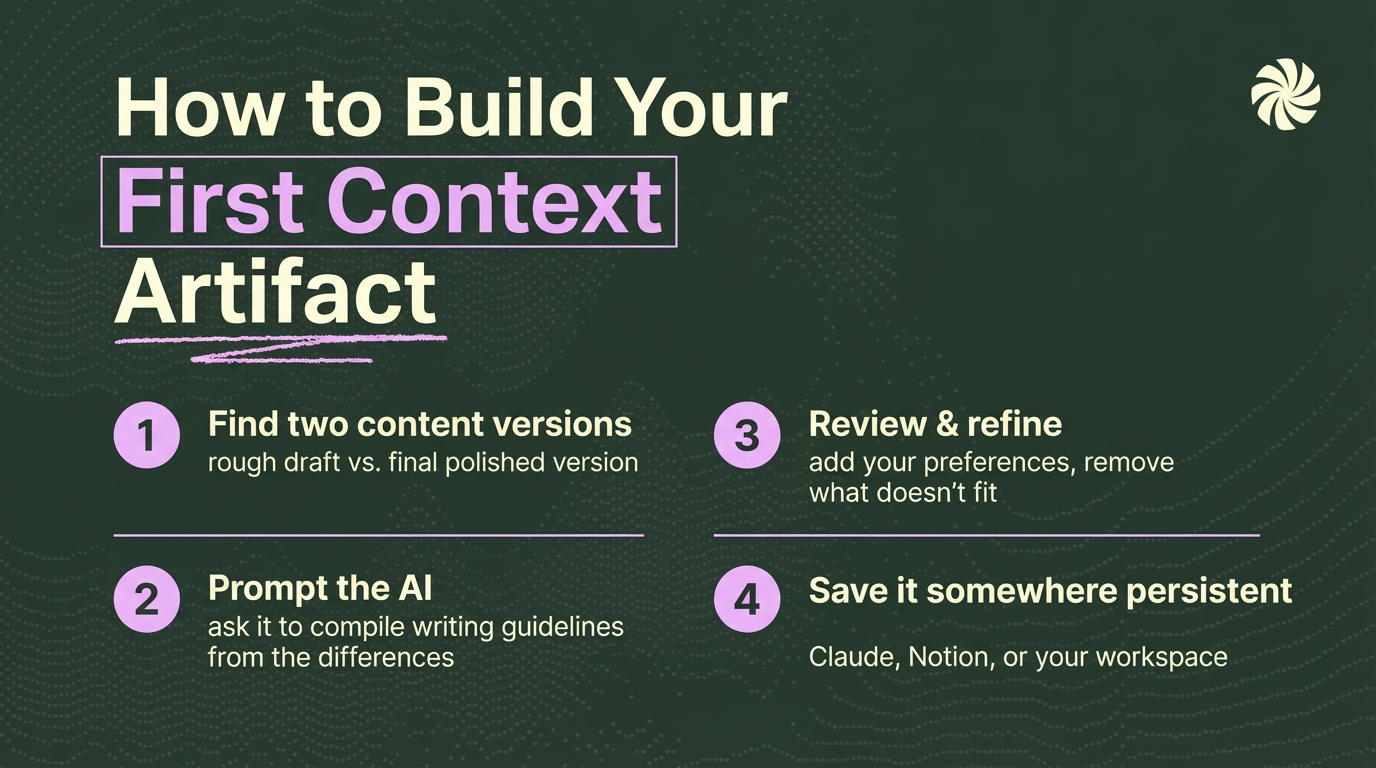
Start with the Voice Guidelines artifact. It has the most immediate, visible impact on output quality, and it's the fastest to build.
Step 1: Find two versions of the same piece of content — your rough draft and the final polished version. The more editorial changes between them, the better.
Step 2: Give both documents to the AI and prompt: "What specific changes did I make between Doc A (draft) and Doc B (final)? Compile detailed writing guidelines based on those changes. Include rules about sentence structure, word choice, punctuation, and tone."
Step 3: Review the output. Add anything the AI missed — your preferences about Oxford commas, how you handle technical terms, whether you use first person or second person. Remove anything that doesn't reflect your actual style.
Step 4: Save the document somewhere persistent — as a project instruction in Claude, a pinned file in your workspace, or a Notion page you can paste from. Use it at the start of every new content conversation.
Time required: about 30 minutes to build the first version. It improves every time you use it and notice gaps.
The full four-artifact system — including the Company Profile, Audience Persona, and Voice-of-Customer artifacts — requires more investment. But starting with voice alone will change your output quality within a single writing session.
Every week, we share real examples and systems the fastest-growing companies are using to scale smarter.
Get the last workshop recording when you sign up.
AEO gets your brand cited inside AI-generated answers. SEO gets it ranked in a list. The gap between those two outcomes is widening — and most brands are only doing one of them.

ChatGPT prompts for marketing that stay specific. Fifteen frameworks for personas, positioning, content, outreach, and experiments.

Answer Engine Optimization (AEO) is the practice of structuring content so AI systems — including ChatGPT, Perplexity, Google AI Overviews, and other LLMs — can extract, understand, and cite your brand in generated answers.