

#AI Growth Playbooks
10 SaaS Marketing Metrics to Track and Why (2026)
The essential SaaS marketing metrics with formulas, stage benchmarks, and practical guidance on CAC, LTV, MRR, churn, NRR, and marketing attribution.
Most teams are running a collection of prompts. What they need is a four-layer system that connects context, research, drafting, and quality control into something repeatable.

An AI content workflow is a repeatable system that uses AI to produce research, drafts, and optimized content at scale — while keeping your brand voice, strategic angle, and quality standards intact.
If you're managing freelancers and AI tools that keep producing generic output, you're treating AI like a writer instead of building it into a content creation workflow.
The distinction matters: a tool produces output. A system produces output reliably. What most content teams are running is a collection of prompts. What they need is a four-layer content workflow that connects context, research, drafting, and quality control into something repeatable.
This guide covers the complete architecture: the four-layer workflow structure, the context artifact system, brief design, quality checkpoints, and how to connect it all to a publishing calendar.
---
Most AI content workflows fail because they're missing the context layer — the AI-readable documents that tell the system who you are, who you write for, and how you sound.
Without context, AI doesn't produce on-brand content. It produces the average of everything it's ever read. The output is technically competent, structurally complete, and completely interchangeable with every competitor's content.
What teams typically do wrong: they write a prompt, get a mediocre draft, edit for an hour, get frustrated, and conclude "AI just doesn't understand our brand." The real problem is that AI can't understand your brand from a prompt alone. It needs a document — a context artifact — that lives above the prompt and gets referenced every time. This is the foundation for every content workflow used at GrowthX and AI Led Growth.
The fix is not a better prompt. It's building the context layer first. Everything else in the workflow depends on it.
---
An effective AI content workflow has four layers: context, research, drafting, and quality control. Remove any one and the system breaks.
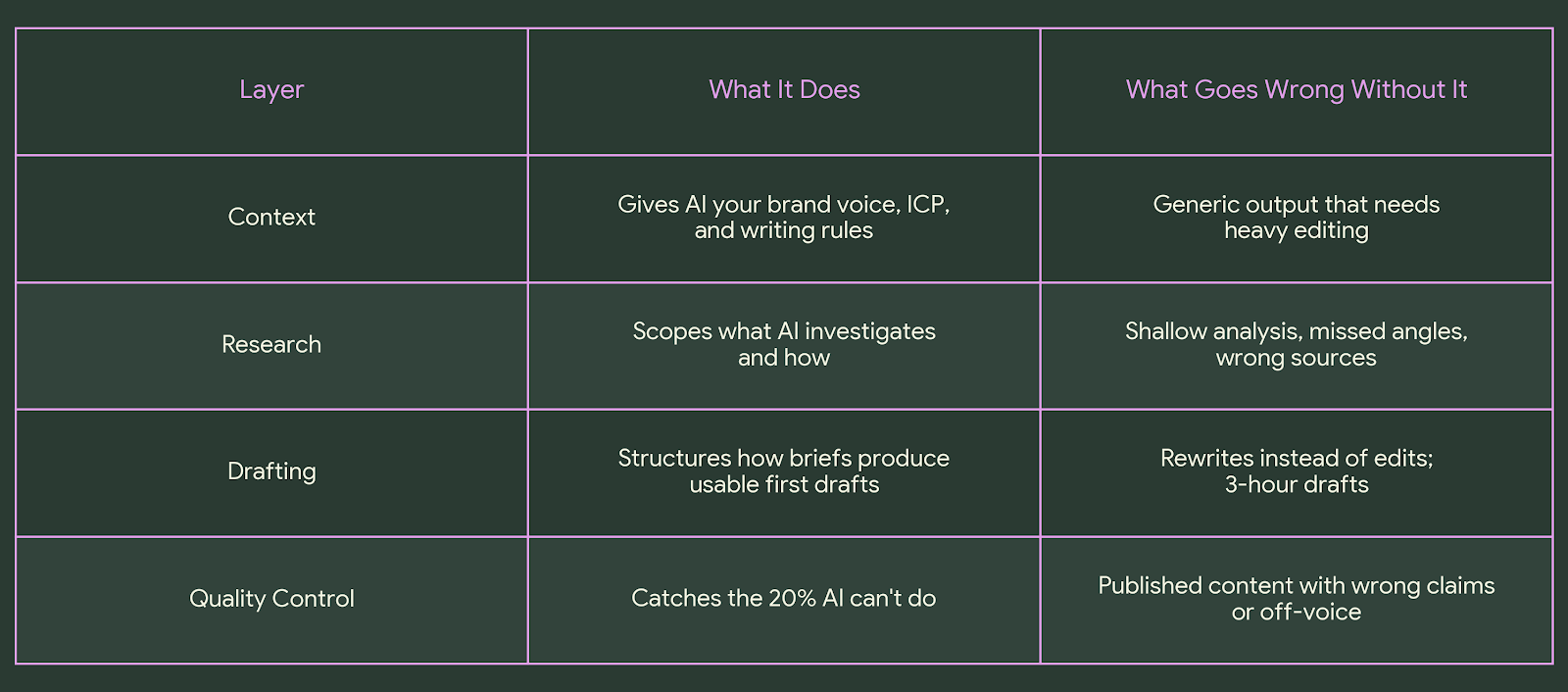
Each layer is necessary. The context layer feeds the research layer. The research layer feeds the drafting layer. The drafting layer feeds quality control. Pull any one layer and the output downstream degrades.
---
Your context layer is the set of AI-readable documents that tell your content creation workflow who you are, who you write for, and how you sound — built once, referenced by every brief from that point forward.
A context artifact has four parts:
How to build one: don't start from scratch. Pull from your existing brand guide, your best-performing articles, and your strongest editorial feedback. Most teams have 80% of this already written — it just needs to be reformatted into a document AI can reference.
Time to build v1: one afternoon. The perfectionism trap is real — don't wait until it's complete. A rough v1 context artifact outperforms no context artifact every time. This is a living document.
What a context artifact is NOT: a prompt. A prompt is an instruction for a single task. A context artifact is a reference document that lives above the prompt and gets loaded into every session.
---
AI research works best when scoped to a specific job — SERP analysis, keyword gap identification, source-finding, or competitor structure mapping — not "write me a research summary."
The generic research prompt produces exactly what it sounds like: a generic summary. No strategic angle, no ICP framing, no opinion. It's the content workflow equivalent of asking a new intern to "look into things."
What AI handles well: pattern recognition across multiple sources, SERP structure analysis, finding citation-worthy sources, identifying what competitors cover and where gaps exist.
What needs a human: primary source verification, client or product nuance, recent events AI doesn't have training data for, and anything that requires judgment about strategic fit.
The research workflow we use for client content at GrowthX:
That last step is what most teams skip. Writing into the gap is what builds topical authority. Writing the same article as your competitors, slightly better, produces mediocre results.
---
The best AI drafts come from over-specified briefs — the more constraint you give the AI, the less editing the output needs.
This is counterintuitive. Most people think more creative freedom produces better AI output. It doesn't. It produces more variable output. Variability in a content development workflow means more editing time, which defeats the purpose of the system.
What makes a good AI brief:
The brief calls the context artifacts without repeating them. The brief is the instruction; the artifact is the reference. "Use the voice rules from the ALG context artifact" is sufficient. You don't re-paste the entire artifact into every brief.
What a usable first draft looks like: something you edit for accuracy and voice — not something you rewrite from scratch. The difference between a 30-minute review and a 3-hour rewrite is entirely in brief quality.
---
Quality control in an AI content workflow is about the 20% of editorial judgment AI can't replicate: ICP accuracy, strategic angle, brand voice enforcement, and factual credibility.
Three quality gates every article should pass before publishing:
Gate 1: Strategic fit. Does this article actually serve the reader you're writing for? Is the angle right — or did the AI drift toward what's commonly said about this topic rather than what's genuinely useful for your ICP? Is the opening paragraph answering the question your reader actually has?
Gate 2: Voice accuracy. Read the first three paragraphs aloud. Does it sound like your brand, or does it sound like the average of the internet? Check against the context artifact. Flag anything that reads as generic, hedged, or vocabulary-adjacent-but-not-quite-right. If you have proprietary frameworks, are they mentioned? (See: The Shaping Loop if you want an example.)
Gate 3: Factual verification. Every stat has a named primary source with a link. Every product claim is accurate. Every internal link goes to the right page. Don't assume the AI got the details right — verify anything you'd be embarrassed to have wrong.
The quality checklist format: a Notion checklist in the content management template. Three gates, each with 2–3 sub-checks. Takes under 15 minutes per article.
Decision rule: if the draft fails Gate 1, send it back to AI with more specific brief instructions. If it fails Gate 2, edit directly — voice correction is faster to do yourself than to re-prompt. If it fails Gate 3, fix the facts; don't regenerate.
---
You connect your AI content workflow to your publishing calendar by treating the workflow as supply and the calendar as demand — for a 1–2 person team, a Monday-to-Friday sprint model produces 3–5 publishable articles per week.
The content creation workflow sprint model:
What a realistic weekly output looks like for a solo content manager running a complete content workflow: 3–5 high-quality articles per week. That's a 3–5x increase from what most content managers produce manually.
The compounding effect takes 3–4 weeks to materialize: the workflow improves every sprint as context artifacts get sharper and brief templates get more refined. The first week produces decent output. Week four produces something you're genuinely proud of.
How to track velocity: measure time from brief to published, editing hours per article, and republishing rate (how often articles need to come back for major revision). Those three metrics tell you whether the workflow is actually working.
---
You don't need a complex stack — most teams run an effective AI content workflow with four categories of tools.
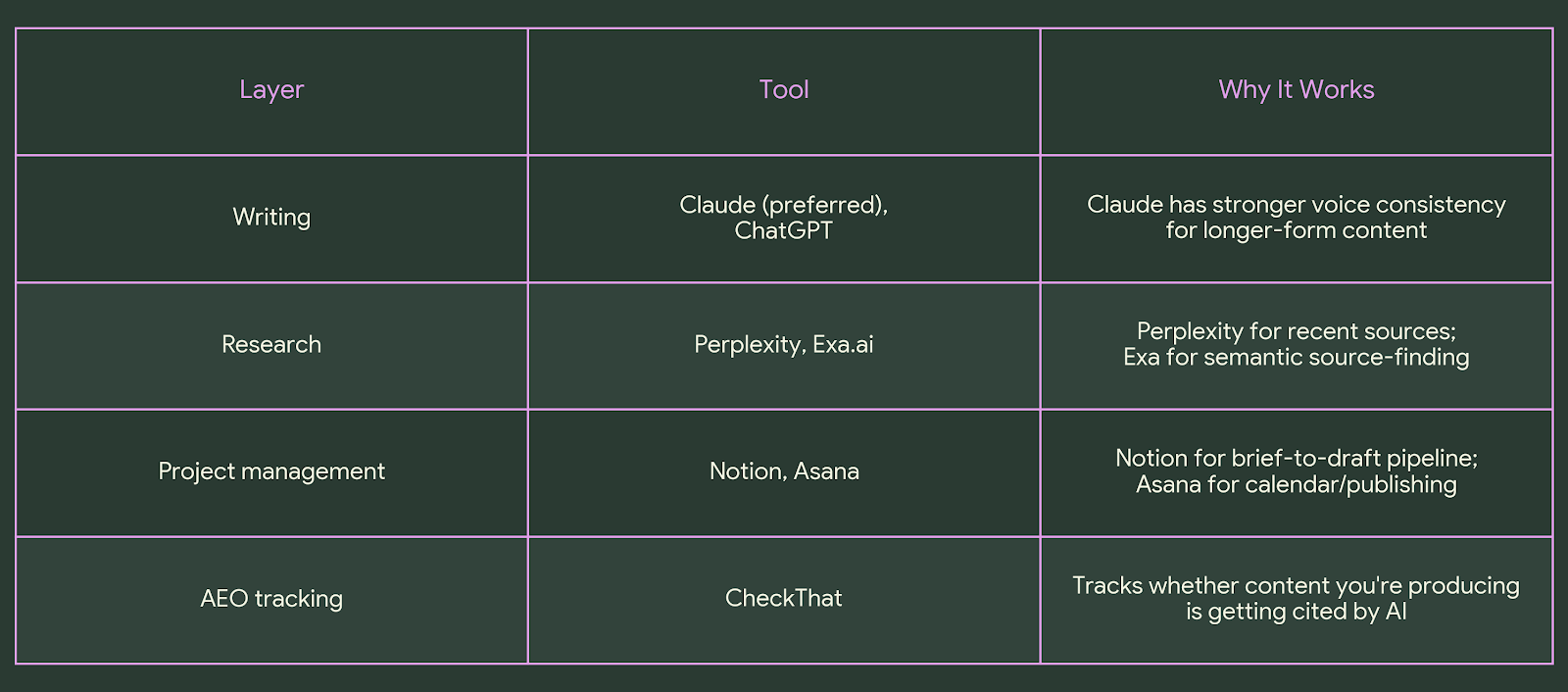
One note on tool selection: the tools matter less than the system. A well-designed workflow running on Claude and Notion outperforms a poorly-designed workflow running on the most expensive enterprise content tool available. Invest in the architecture first.
---
Get the workflows, templates, and a community of operators building these systems. Join AI-Led Growth
Every week, we share real examples and systems the fastest-growing companies are using to scale smarter.
Get the last workshop recording when you sign up.
The essential SaaS marketing metrics with formulas, stage benchmarks, and practical guidance on CAC, LTV, MRR, churn, NRR, and marketing attribution.

Market research prompts that return a specific answer. Ten AI frameworks for segmentation, sentiment, competitors, personas, market sizing, and test hypotheses.

AI systems are shortlisting your competitors for your buyers before they ever visit your website. This is how you get on the list.