

#AI Growth Playbooks
10 SaaS Marketing Metrics to Track and Why (2026)
The essential SaaS marketing metrics with formulas, stage benchmarks, and practical guidance on CAC, LTV, MRR, churn, NRR, and marketing attribution.
AI systems are shortlisting your competitors for your buyers before they ever visit your website. This is how you get on the list.

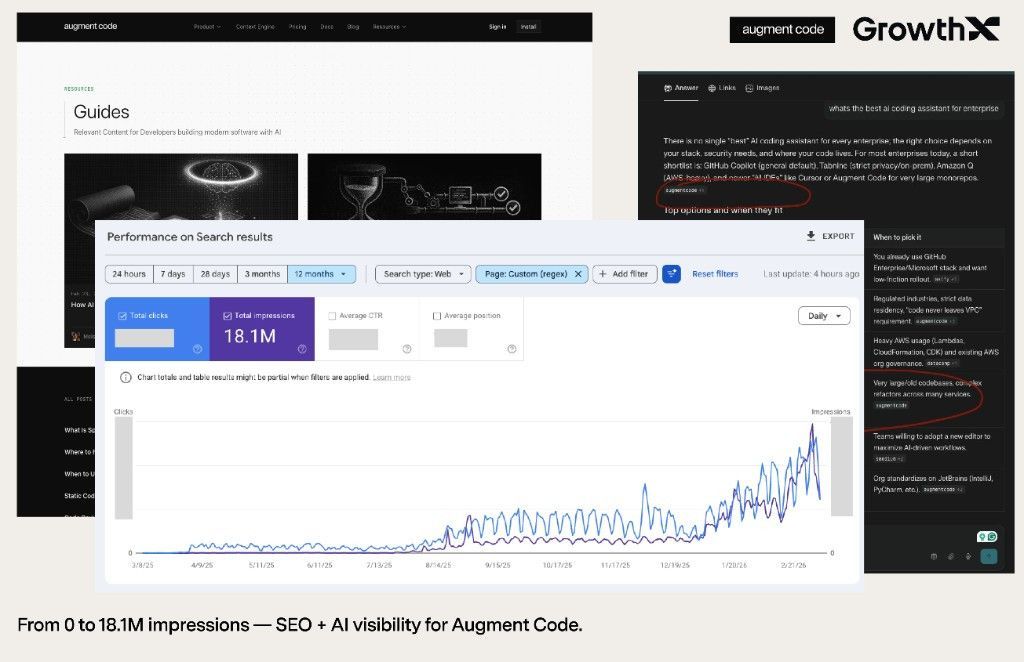
Four months ago, Augment Code wasn't showing up in any AI answers for enterprise coding queries. No mentions in ChatGPT. No citations in Perplexity. Gemini didn't know they existed — despite strong analyst recognition and solid organic traffic.
We mapped their full citation graph, built intent trees for the highest-value queries, and restructured their content for extraction. Then we got them mentioned in the articles AI models were already trusting and citing. Four months later: #1 across ChatGPT, Perplexity, and Gemini for enterprise coding queries. Domain rating: unchanged.
This article breaks down that process — what we changed, in what order, and what you can implement on your own content this week.
---
AI systems cite content structured for extraction, not content written for ranking. When you ask ChatGPT or Perplexity a question, the system retrieves 40–60 word chunks of content from across the web and synthesizes them into an answer. If your answer isn't in the first sentence of a section, that chunk is unciteable — regardless of how authoritative your domain is.
This process is called Retrieval-Augmented Generation (RAG). Research from Ahrefs and analyst Kevin Indig found near-zero correlation between domain authority and AI citation frequency. A Profound study of 2.6 billion AI responses found that structured content — lists, comparison tables, FAQ sections — accounts for 25.37% of all AI citations, significantly outperforming long-form prose. A larger link profile won't change that. A different content structure will.
For a deeper look at how Answer Engine Optimization works and why it's distinct from traditional SEO, start there first.
---
The three changes that most directly affect citation frequency are: BLUF-led sections, FAQ sections with schema markup, and explicit entity definitions. Implement all three on your highest-traffic pages before anything else — these are the structural prerequisites for AI retrieval, and without them, other optimization efforts won't move the needle.
BLUF every section. Rewrite the first sentence of every H2 to be the complete answer to the implied question. AI systems retrieve the first 40–60 words of a chunk — if the answer isn't there, the chunk doesn't get cited.
Here's what this looks like in practice. Before a BLUF rewrite:
"Before we can understand what makes content rankable in AI search, it's important to look at how retrieval systems actually work. Over the past few years, the way AI processes web content has changed significantly..."
After:
"AI systems cite content that leads with the answer. Retrieval systems extract the first 40–60 words of a section — if your answer is buried in the third sentence, the chunk is unciteable."
The second version gives the AI a complete, quotable statement in the first line. The first version gives it nothing extractable until the third paragraph.
Add FAQ sections with schema markup. A FAQ section with one H3 per question, the answer in the first sentence, and FAQ schema (JSON-LD) implemented correctly is the highest citation-density format in AI retrieval. It captures People Also Ask boxes in traditional search at the same time — a two-for-one that no other format matches.
Make your entity claims explicit. AI systems build their understanding of your brand from co-occurrence patterns across the web. They won't infer what your company does from product-speak. A phrase like "Acme is a project management tool for software development teams" should appear in clear prose on your homepage, about page, and key product pages. State it directly, in plain language, and repeat it across every page that matters.
---
The five content formats AI systems cite most frequently are: FAQ sections, comparison tables, numbered step-by-step lists, definition sections, and original data with named sources. Long-form narrative prose is the lowest-cited format regardless of quality. Restructuring existing content into these formats will lift citation frequency faster than publishing new content.
Format hierarchy for AI citation, ranked by citation rate:
1. FAQ sections — highest citation rate per Profound data; also captures PAA boxes in traditional search. One question per H3, answer in the first sentence.
2. Comparison tables — "X vs. Y" format. AI systems retrieve and cite table rows as structured data; significantly more extractable than descriptive paragraphs.
3. Numbered step-by-step lists — sequential structure extracts cleanly. AI can cite individual steps without needing surrounding context.
4. Definition sections — "X is Y" openings in standalone sections get pulled for definitional queries. A clear, quotable definition creates a citation surface for every user asking "what is X?"
5. Original data and statistics — AI systems heavily favor citing specific numbers with named sources. Original research creates a citation surface no one else can replicate — and every time another site references your data, that's another entity association being built.
Formats that underperform in AI citation:
As Exec's Sean Linehan put it: "Everyone's making AI content, but it's generic and not that good. We needed AI scaffolding to produce content that's legitimately valuable and human-guided." The format requirements for AI citation and the quality requirements for human readers point in the same direction. Clear, direct, well-organized content performs on both.
---
Citation is only possible if your content is in the retrieval pool for the prompts your buyers are actually typing. The first step is mapping those prompts — not guessing at them, but building an intent tree that shows exactly which queries branch into which sub-topics, and what content you need at each node.
With Augment Code, we started by identifying the parent query: "best enterprise coding assistant." From there, the intent tree branched into security, deployment, team onboarding, compliance, and specific stack comparisons. Each branch needed its own page — a broad "enterprise coding tools" page couldn't cover the sub-intent well enough to get cited. Going deep on a handful of high-intent branches outperformed trying to cover every angle with a single piece.
For B2B SaaS companies, the highest-value prompt types follow the same pattern:
Start by running your top 10 category prompts in ChatGPT and Perplexity this week. Record who gets cited, what structure their content uses, and which prompt variations return the most mentions. That map tells you exactly where the content gaps are.
CheckThat automates the ongoing version of this — tracking which prompts return your brand across platforms, surfacing which competitors are being cited instead, and identifying which of your pages are doing the citation work.
---
One of the most common mistakes in AEO is treating "AI search" as a single system. ChatGPT, Perplexity, and Gemini use different retrieval signals — and what moves the needle on one platform won't necessarily move it on another.
Working across all three for Augment Code, this became clear quickly. Each engine had a distinct pattern:
Most AEO advice treats all three platforms as interchangeable. They aren't. If you're seeing strong Perplexity performance but flat ChatGPT results, the fix is different than if the reverse is true. Optimize per engine once you have baseline data.
---
The authority signals that predict AI citation are distinct from traditional SEO authority signals — and more achievable for teams without large link-building budgets. Build these in parallel with your structural content changes.
Named entity presence. Your brand name and what you do appearing together consistently across many pages and sites — not just your own. AI systems build entity associations from co-occurrence patterns. The more frequently "Augment Code" and "enterprise AI coding assistant" appeared together across authoritative sources, the stronger that association became in the citation graph.
The citation layer — getting mentioned in articles AI models already trust. This was the biggest single unlock for Augment Code. Publishing new pages is the obvious move. Getting your brand mentioned in existing articles that AI models already retrieve and cite moves things faster. Identify which third-party articles are showing up in AI answers for your category queries, and work to get your brand mentioned in those articles — through outreach, updated listicle inclusions, or contributing data those articles can cite. One authoritative mention in a well-cited resource can do more for your AI citation rate than ten new pages on your own domain.
Third-party mentions across newsletters and community discussions. Being referenced in industry newsletters, Slack communities, and analyst reports trains AI systems to associate your brand with a category. One mention in a Forrester report produces more entity association than fifty link-building outreach emails.
Original data and research. Numbers you publish that other sites cite. AI systems treat original research as high-authority citation sources. Every citation creates another entity association — and a citation surface that no competitor can replicate.
Structured data (schema markup). Organization schema, FAQ schema, HowTo schema. These are direct signals to AI retrieval systems about what your content covers and what your entity is. Gemini in particular rewards structured schema signals.
To audit your current entity clarity, paste your homepage into ChatGPT and ask "What does this company do?" The answer is what AI systems currently believe about your brand. If it's vague or wrong, fix the entity definition layer before optimizing anything else — accurate brand associations are the foundation everything else builds on.
---
AI citation visibility is a separate metric from search rankings and requires separate measurement. An SEO rankings dashboard won't show whether ChatGPT is recommending your brand — you need to track citation frequency across AI platforms independently.
Track: citation frequency across ChatGPT, Perplexity, and Google AI Mode; which prompts cite you; what competitors are cited instead; which of your pages are the citation sources.
Manual approach: build a list of your category's key prompts and run them weekly, recording who appears and what gets cited. Slow, but free — and it gives you a real baseline before you invest in tooling.
The automated approach is what Exec used when growing their talent development platform. By tracking prompt-level visibility systematically, they could see exactly where they were gaining ground and iterate week over week. The result: 4,531% growth in LLM referral traffic over six months (from 16 to 741 sessions), a 343% increase in URL clicks, a 307% increase in impressions, and 31 demos and signups booked in the first four weeks.
CheckThat does this at scale — tracking brand visibility across AI responses, pre-loaded with B2B category prompts, so you can benchmark your citation rate against competitors without building the tracking infrastructure manually.
Set a baseline now. The first-mover window is still open — but it's closing.
---
Structural changes affect citation frequency within 4–8 weeks for ChatGPT and Perplexity. Google AI Overviews take longer because they require top-10 SEO rankings as a prerequisite. New entity associations across AI systems take 8–12 weeks to build at scale.
By platform:
Augment Code's results came faster than the typical timeline because the citation layer work — getting mentioned in already-trusted articles — and the structural changes happened simultaneously. The two compound: better structure increases citation likelihood when AI retrieves a page; third-party mentions increase how often AI retrieves the page to begin with.
---
The tactics above work best in a specific sequence. Trying to run all of them at once spreads effort thin and makes it harder to isolate what's working.
Week 1 — Run the baseline audit. Paste your homepage into ChatGPT and ask "What does this company do?" Note what it says. Then run your top 10 category prompts in ChatGPT and Perplexity and record who gets cited and what their content structure looks like. Two hours of work, and it tells you exactly where the gaps are.
Week 2–3 — Structural changes on your top 3 pages. Rewrite the first sentence of every H2 to lead with the answer. Add a FAQ section with FAQ schema (JSON-LD) — one H3 per question, answer in the first sentence. Make explicit entity claims on your homepage, about page, and primary product page.
Week 4–6 — Intent tree and content gaps. Map your top 5 category queries into intent branches. Identify which sub-topics have no dedicated page and prioritize 2–3 new pages targeting specific prompt branches your coverage is missing.
Month 2 — Citation layer. Identify which third-party articles are currently being cited for your category's top prompts. Work to get your brand mentioned in those articles — outreach for listicle inclusion, contribute data they can cite, provide expert quotes.
Ongoing — Track per engine. Monitor citation frequency separately for ChatGPT, Perplexity, and Gemini. Each platform moves at a different rate and responds to different signals.
---
Most brands missing from AI answers are writing good content with bad structure — content that answers the right questions but buries the answers deep enough that AI retrieval systems can't extract them. The five mistakes below account for the majority of preventable citation failures.
Writing for traditional SEO without adding AEO structure. Well-researched, properly keyword-optimized content that's unciteable because the answers sit inside paragraphs rather than leading sections.
Optimizing only for Google AI Overviews and ignoring ChatGPT and Perplexity. These are different systems with different retrieval patterns. Google AI Overviews are SEO-gated. ChatGPT and Perplexity are not — ignoring them leaves a more accessible channel completely untouched.
Assuming high domain authority guarantees citation. DA and DR are near-zero predictors of how frequently AI systems cite your content. Structure and entity clarity are the determining factors.
Not making explicit entity claims. AI systems won't infer your brand's positioning from your pricing page. Direct entity definitions — stated clearly, in plain language, repeated across key pages — are how accurate brand associations get built.
Not tracking citation separately from rankings. Citation frequency is a distinct metric that requires distinct measurement. An SEO dashboard alone won't surface it.
---
Every week, we share real examples and systems the fastest-growing companies are using to scale smarter.
Get the last workshop recording when you sign up.
The essential SaaS marketing metrics with formulas, stage benchmarks, and practical guidance on CAC, LTV, MRR, churn, NRR, and marketing attribution.

Market research prompts that return a specific answer. Ten AI frameworks for segmentation, sentiment, competitors, personas, market sizing, and test hypotheses.

Most teams are running a collection of prompts. What they need is a four-layer system that connects context, research, drafting, and quality control into something repeatable.