

#AEO
ChatGPT Prompts for Marketing (2026)
ChatGPT prompts for marketing that stay specific. Fifteen frameworks for personas, positioning, content, outreach, and experiments.
AEO gets your brand cited inside AI-generated answers. SEO gets it ranked in a list. The gap between those two outcomes is widening — and most brands are only doing one of them.

AEO and SEO are not competing strategies — they optimize for different systems. SEO gets your content ranked in a list of results. AEO gets your brand cited inside the answer itself. The gap between those two outcomes is widening as more B2B buyers use ChatGPT and Perplexity for vendor research, category education, and shortlist building — before they ever run a Google search.
If something about "Answer Engine Optimization" landed in your inbox recently and your first question was whether it replaces SEO or adds to it: the answer is that it adds to it. Both matter. They just require different things from your content.
---
AEO — Answer Engine Optimization — is the practice of structuring content so AI systems like ChatGPT, Perplexity, and Google AI Overviews extract and cite your brand in generated answers. Where SEO targets Google's ranking algorithm, AEO targets the retrieval and synthesis systems that power AI-generated responses.
When someone asks Perplexity "what's the best project management tool for dev teams," the brands that appear in the answer didn't get there through rankings alone. They structured their content so AI systems could extract and reuse specific chunks. That's the difference. The full breakdown lives in What is AEO?
The distinction that matters most for this comparison: SEO wins you a position in a ranked list. AEO wins you inclusion in the answer itself.
---
SEO optimizes for a ranking. AEO optimizes for citation. The systems they target, the signals they use, and the content formats they reward are fundamentally different — even when the underlying content is the same page.
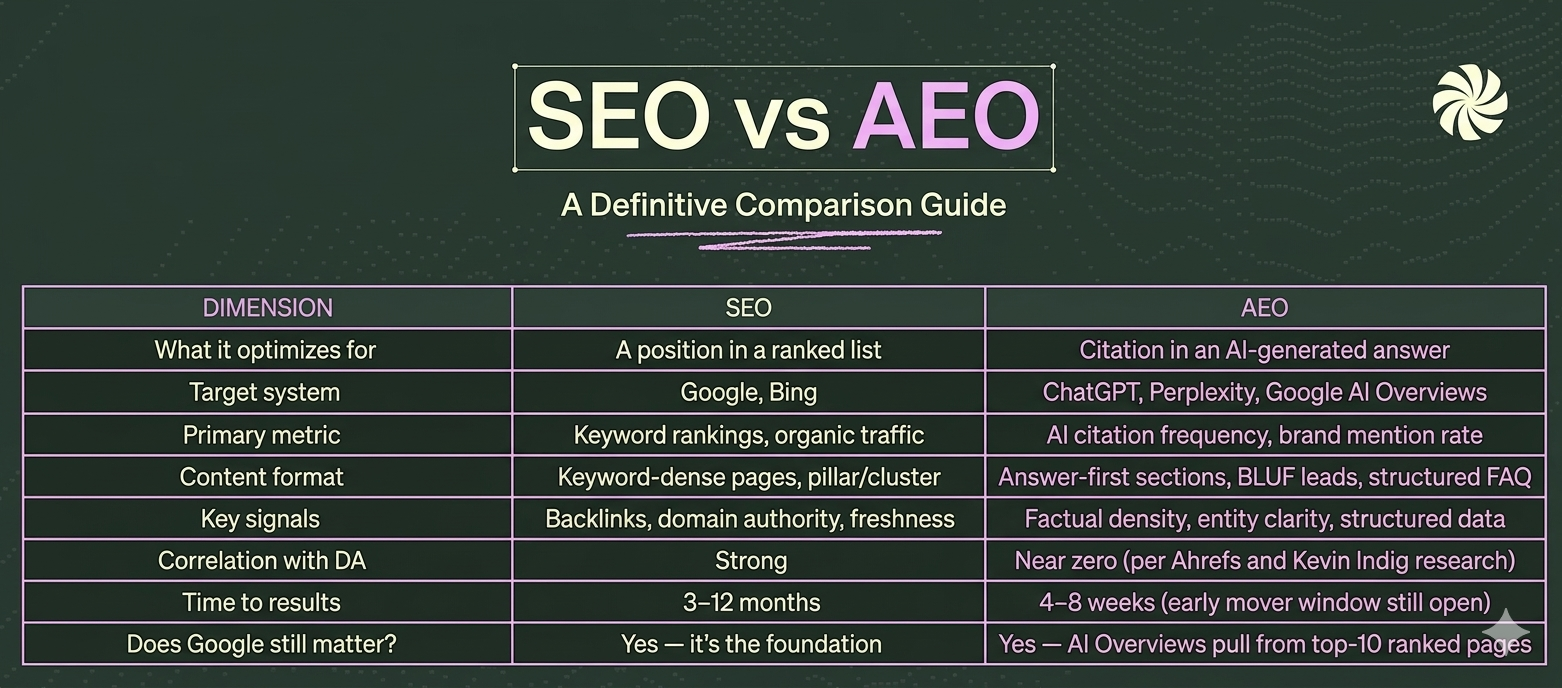
The signals don't fully conflict — they overlap significantly. The differences surface at the execution level: how individual sections are structured, how FAQs are handled, and what gets done with schema markup.
---
The majority of strong SEO practice is also strong AEO practice. High-quality content on a crawlable site is the prerequisite for both. Topical authority signals matter to both — AI systems favor sites with deep, comprehensive coverage. And backlinks still correlate with AI citation on Google's systems, since AI Overviews draw from the top 10. According to ZipTie (2025), ranking #1 in Google gives you a 25% chance of being cited in AI Overviews.
Where they diverge — and this is where the execution gap opens up:
---
AEO doesn't require a rebuilt content strategy. It requires a structural layer added to what you're already writing. Four specific changes, in order of citation impact:
Lead every H2 section with the answer. "What is X?" opens with "X is Y" — a direct, complete answer in the first sentence. AI systems retrieve the first 40–60 words of each content chunk. Everything after that is supporting detail. Content that buries the answer after two paragraphs of context never gets extracted.
Add an FAQ section to every major piece. Use H3 tags, FAQ schema markup (JSON-LD), and one clear answer per question. This is the single highest-citation format in AI retrieval, and it captures People Also Ask boxes in traditional search at the same time.
Make your entity claims explicit. AI systems build their understanding of your brand from co-occurrence patterns across the web. Ambiguous product copy won't produce clear entity associations. If you do project management software for engineering teams, state that directly and repeatedly — on your homepage, about page, and key landing pages.
Track AI visibility as a separate metric. Rankings and citations are different numbers that require different measurement. Your SEO dashboard won't tell you whether ChatGPT is recommending your brand. CheckThat tracks citation frequency across ChatGPT, Perplexity, and Google AI Mode so you can see where you stand and where competitors are pulling ahead. See how your brand shows up in AI search → Try CheckThat free
---
Yes — but the investment split depends on where you are. SEO and AEO compound each other: brands cited in AI Overviews earn 35% more organic clicks and 91% more paid clicks than non-cited brands (Graphite, 2025). The most effective approach runs both in parallel, with AEO structured as a layer on top of existing SEO work.
What a real SEO foundation looks like in practice: Webflow went from zero to 30K visitors a week on a content engine GrowthX built for them. The system ingests product docs, partner docs, and support tickets — so when a new integration page is needed, context already exists. They're publishing around 30 integration pages a week at that quality. The part worth noting: when one gap was identified (pages lacking real-world examples), one upgrade — pulling Reddit discussions filtered by upvotes — improved every page, past and future. That's what treating content like a product instead of a project looks like. AEO is what you layer on top of that foundation to get cited inside AI answers, not just ranked in a list.
A short decision framework:
On timing: the competitive gap in AEO is still wide. Over 50 AEO-specific tools have emerged since 2024 (Graphite, 2025), signaling a maturing discipline — but most brands aren't executing it correctly yet. This is where SEO was in 2015.
---
The most common misconception is that AEO replaces SEO. It doesn't — and teams that treat it as a replacement end up with neither channel working well. The four misconceptions below account for most of the bad takes circulating on this topic.
"AEO replaces SEO." AEO and SEO serve different systems. Google still drives the overwhelming majority of organic traffic. AI Overviews require top-10 SEO rankings as a prerequisite. There's no version of AEO that works without a crawlable, well-structured site underneath it.
"Domain authority determines AI citations." DA and DR are near-zero predictors of how frequently AI systems cite your content. A competitor with a DR 40 site and clean BLUF structure will regularly out-cite a DR 80 site written in dense narrative prose. Structure and factual density are the determining factors in LLM citation models.
"AEO is only for top-of-funnel, definitional content." B2B buyers use ChatGPT and Perplexity at every stage of the funnel — including vendor comparison, feature evaluation, and pricing research. Someone asking Perplexity "what's the best HubSpot alternative for a 50-person sales team" is a bottom-of-funnel buyer prompt, not a definitional one. AEO visibility matters at that stage just as much as when they ask "what is CRM?"
"AEO is the same as featured snippet optimization." There's overlap in the structural principles — clear answers, well-organized sections — but featured snippets are a Google SERP feature. AEO covers ChatGPT, Perplexity, and other AI systems that don't use snippets at all. The scope is wider and the measurement is separate.
---
Every week, we share real examples and systems the fastest-growing companies are using to scale smarter.
Get the last workshop recording when you sign up.
ChatGPT prompts for marketing that stay specific. Fifteen frameworks for personas, positioning, content, outreach, and experiments.

Context artifacts are reusable documents that give AI everything it needs to produce consistent, on-brand output — every time you start a new session. Here's the four-artifact system that separates production-grade AI content from generic output.

Answer Engine Optimization (AEO) is the practice of structuring content so AI systems — including ChatGPT, Perplexity, Google AI Overviews, and other LLMs — can extract, understand, and cite your brand in generated answers.