

#AEO
AEO vs. SEO: What's the Difference? (And Do You Need Both?)
AEO gets your brand cited inside AI-generated answers. SEO gets it ranked in a list. The gap between those two outcomes is widening — and most brands are only doing one of them.
GEO is the layer on top of SEO that determines whether your content gets pulled into an AI response — or disappears entirely while a competitor gets cited instead.

Generative Engine Optimization (GEO) is the practice of structuring content so AI systems — ChatGPT, Perplexity, Google AI Overviews — can retrieve, synthesize, and cite your brand in generated answers.
It's not a replacement for SEO. It's the layer on top of it that determines whether your content gets pulled into an AI response or disappears entirely while a competitor gets cited instead.
In 2023, Gartner predicted that organic search traffic would decline by 25% by 2026 as AI-generated answers absorb queries that used to lead to a click. That window is already closing. Generative engine optimization is how you stay visible as it does.
This article covers: what GEO is, how it differs from AEO and SEO, how it works technically, five tactics with the highest citation correlation, common misconceptions, and how to track performance.
---
Generative Engine Optimization (GEO) is the practice of structuring your content so AI systems — ChatGPT, Perplexity, Claude, Google AI Overviews — retrieve it, synthesize it, and cite your brand in their generated answers.
The term originates from a 2023 Princeton research paper, "GEO: Generative Engine Optimization," which analyzed how content structure, authority signals, and factual density affect citation frequency in AI-generated responses. It became the practitioner shorthand for everything involved in getting your brand into AI answers.
GEO is a subset of AEO (Answer Engine Optimization). AEO is the broader category covering all answer-first content optimization. GEO specifically targets generative AI models — the systems that synthesize new answers from retrieved sources, rather than returning ranked links. If you're optimizing for ChatGPT or Perplexity, you're doing GEO.
AI systems are no longer just used for definitional questions. B2B buyers are using ChatGPT and Perplexity for product research, category evaluation, and vendor comparison. GEO matters for your pricing page as much as your "what is" content.
---
GEO, AEO, and SEO serve overlapping but distinct goals — here's a direct comparison of how each works and which metrics matter.
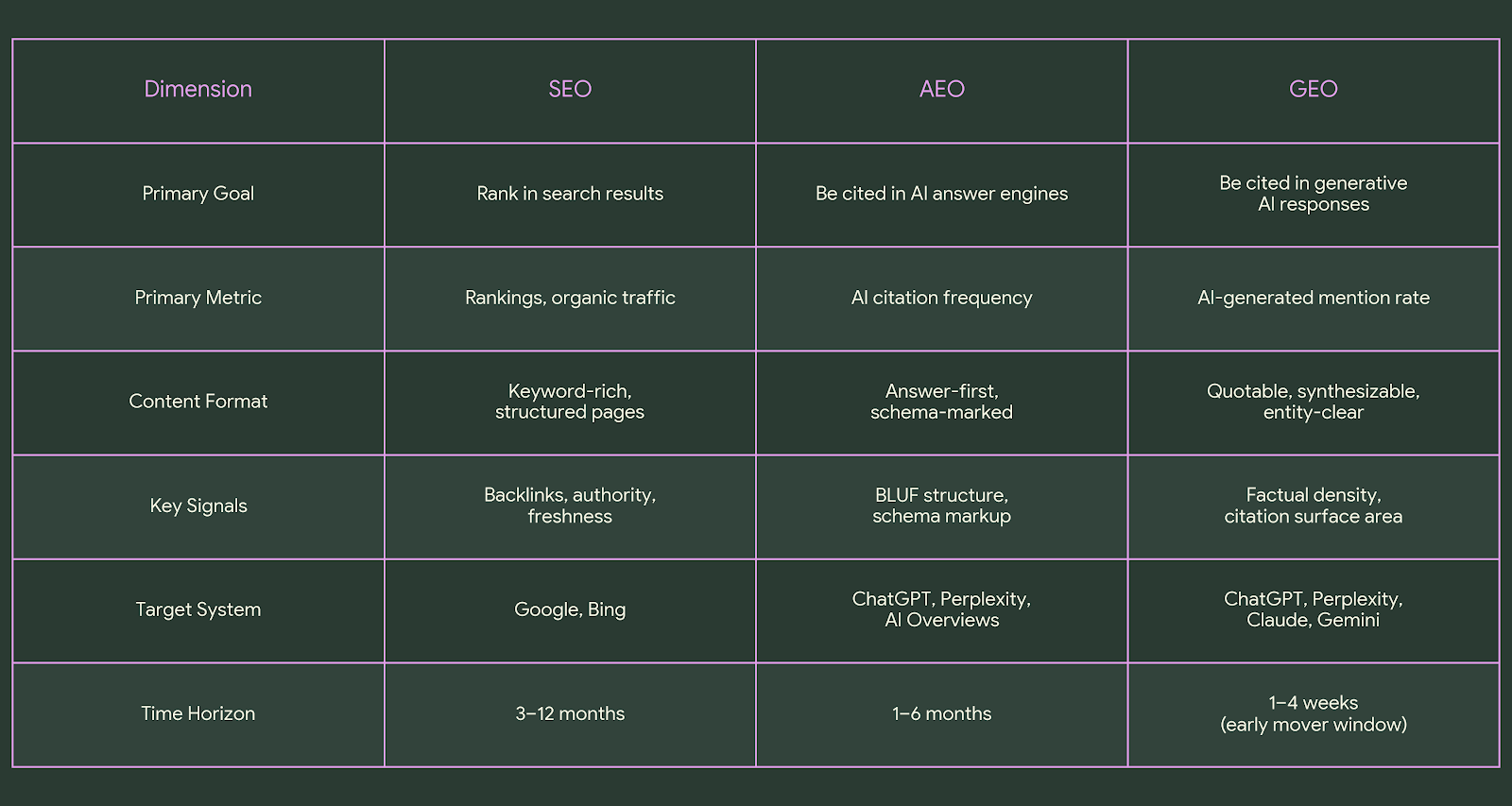
One clarification worth making: in practice, GEO, AEO, LLMO, and LLM SEO are used interchangeably by practitioners. The optimization principles are the same. What matters is the practice, not the label.
SEO is still the foundation. Google AI Overviews pull from pages already in the top 10, so strong SEO is a prerequisite for GEO on Google. For ChatGPT and Perplexity, structure and content quality matter more than ranking position.
---
Generative engine optimization works through RAG (Retrieval Augmented Generation) — AI systems retrieve 40–60 word chunks from your content, synthesize them across multiple sources, and generate a cited answer. Structure and extractability determine whether your content gets used, not domain authority or ranking position.
Here's how the RAG process works: when a user asks a question, the AI retrieves relevant content chunks, synthesizes those chunks, and generates a response while sometimes citing the sources. The chunks it extracts are typically 40–60 words from the opening of each section. If the answer isn't in the first sentence, the chunk is unciteable.
This is why traditional SEO metrics don't predict AI citation performance. Research from Ahrefs and Kevin Indig found near-zero correlation between domain rating, backlink count, or keyword rankings and AI citation frequency. A DR 30 page with clear, structured answers gets cited more often than a DR 80 page with dense, prose-heavy content.
Citation pattern data from Profound — across 2.6 billion AI response data points — found that listicle-format content (structured lists, comparison tables, numbered sequences) accounts for 25.37% of all AI citations. Prose paragraphs, however well-written, extract poorly.
The work is structural. You're restructuring what you already have.
---
The tactics that increase GEO citation rate most reliably are structural: BLUF rewrites, comparison tables, FAQ sections, entity clarity in the first 100 words, and multi-platform citation surface area — all five work on existing content without requiring new articles.
1. Lead every section with a complete, standalone answer. The BLUF rewrite: move the conclusion to sentence one of every H2 section. AI extracts 40–60 words from the top of each section. If the first sentence is "In today's digital landscape," that chunk is useless. If it fully answers the section question, it becomes a citation candidate.
2. Add structured formats AI can extract. Comparison tables, numbered lists, and definition blocks extract cleanly. Dense prose does not. Find any section where you're comparing two things in prose — replace it with a table. Find any sequence — number it. Find any "what is" paragraph — format it as a definition block.
3. Build a FAQ section targeting People Also Ask queries. Write 5–7 FAQ questions using exact phrasing from Google's PAA boxes. Each answer: 40–80 words, answer-first, fully self-contained. Add FAQPage schema markup. This is the highest AI citation format on most pages — readable without any context from the rest of the article.
4. Add entity clarity in your first 100 words. State your company name, category, and primary use case explicitly at the top of every page. AI systems are identifying what entity a piece of content is about. If your brand name, product category, and core value prop aren't explicit in the opening paragraph, you're invisible to that extraction layer.
5. Build citation surface area beyond your website. Reddit threads. YouTube videos. Third-party listicles. AI systems treat multi-source frequency as a trust signal. One page on your domain = one data point. Five independent sources mentioning your brand in the same context = consensus. Consensus is what gets cited. At GrowthX, we ensure we have up-to-date and relevant context artifacts for each of our clients so that the output is consistent and the claims withstand.
---
The most common GEO misconceptions are that it's just SEO with a new name, that AEO coverage means you're already covered for GEO, that it requires new content, and that it only matters for top-of-funnel pages — all four lead teams to underinvest in GEO at the worst moment.
Misconception 1: GEO is just SEO with a new name. GEO targets the synthesis layer of AI — citation frequency in generated output, not ranking position. A page can rank #1 on Google and have zero AI citations. They optimize for different systems with different signals. The practices are not the same.
Misconception 2: If you're already doing AEO, you're covered for GEO. AEO is the broader practice. GEO specifically targets generative AI models (ChatGPT, Claude, Gemini). Different platforms have different citation patterns — optimization for Google AI Overviews doesn't guarantee coverage in ChatGPT. You need to test and track across platforms. CheckThat can help.
Misconception 3: GEO requires completely new content. Most GEO work is structural — rewriting opening sentences, adding comparison tables, building FAQ sections. The content you have is the raw material; the structure is what needs to change. For most teams, optimizing the top 20 pages by traffic is the right starting point before creating anything new.
Misconception 4: GEO only matters for top-of-funnel awareness content. AI systems are increasingly used for product evaluation and vendor comparison. If a buyer is asking ChatGPT "what's the best content analytics tool for B2B SaaS?", that's a bottom-of-funnel query. GEO is as important for your pricing and comparison pages as for your definitional content.
---
You track GEO performance by measuring citation frequency across AI platforms — ChatGPT, Perplexity, Claude, and Google AI Mode — using dedicated monitoring tools, since traditional rank trackers don't capture AI citations at all.
What to track: citation frequency by platform, brand mention rate in AI responses across your target queries, and which competitor pages are getting cited instead of yours.
Tools to use:
The metric to start with: citation rate — what percentage of your target queries result in a citation of your brand. Start there before going deeper into platform-specific breakdowns.
---
Track how often your brand gets cited in ChatGPT, Perplexity, and Google AI Mode — and see where competitors are showing up instead. Try CheckThat free
Every week, we share real examples and systems the fastest-growing companies are using to scale smarter.
Get the last workshop recording when you sign up.
AEO gets your brand cited inside AI-generated answers. SEO gets it ranked in a list. The gap between those two outcomes is widening — and most brands are only doing one of them.

ChatGPT prompts for marketing that stay specific. Fifteen frameworks for personas, positioning, content, outreach, and experiments.

Context artifacts are reusable documents that give AI everything it needs to produce consistent, on-brand output — every time you start a new session. Here's the four-artifact system that separates production-grade AI content from generic output.