

#AEO Tools
12 Reasons to Use AI Search Monitoring Tools
A practical guide to why AI search monitoring tools belong in a growth stack — covering automation, competitive intelligence, intent tracking, local visibility, and revenue attribution.
We tested 11 AEO analysis tools — free checkers, graders, and audit platforms — with pricing, scores, and honest verdicts to measure your AI search readiness.

You already know what AEO is. You've read the headlines about AI search eating into organic traffic. But here's the question nobody seems to answer: how do you actually check if your content is ready for it?
That's where AEO analysis tools come in. The best AEO checker or LLM SEO analysis tool does for AI search what the old HubSpot Website Grader did for your homepage in 2010 — it gives you a score, a reality check, and a starting point. These tools audit your content, structured data, and brand presence against the factors that determine whether ChatGPT, Perplexity, or Google AI Overviews will cite you.
We tested 11 AEO analysis tools — from free single-page checkers to platform-level audit suites — so you can find out where you stand before committing to a full AEO strategy. Here's what we found.
An AEO analysis tool evaluates how well your website, content, and structured data are positioned for AI search engines. Think of it as an AI search audit for your digital presence.
These tools produce a point-in-time assessment. That's the key distinction. Unlike AI search visibility tools that provide ongoing monitoring , AEO analysis tools answer a snapshot question: Right now, today, how AI-ready is my content?
The outputs vary by tool, but you'll typically get some combination of an AEO score or AI-readiness grade, a content audit report, schema and structured data analysis, and a citation probability estimate. Some tools focus on brand-level visibility across AI engines, while others crawl your pages and score them on technical factors.
The category is new. Most of these tools launched in 2025 or early 2026. That means the scoring methodologies differ wildly, and no industry standard exists yet. Keep that in mind as we walk through the options.
Before picking a tool, it helps to understand what these checkers are actually evaluating. Not every tool measures every factor, but here are the common dimensions:
Content structure and clarity. AI models prefer Q&A blocks, concise definitions, and modular sections that can be extracted independently. Checkers look for question-style headers, answer paragraphs in the 40–60 word range, and comparison tables.
Schema markup and structured data. FAQ schema, HowTo schema, Article schema, Organization markup — structured data helps AI crawlers parse your content with confidence. Pages with proper JSON-LD get cited more reliably.
E-E-A-T signals. Author bylines, credentials, cited sources, publication dates, freshness indicators. Google's AI Overviews lean heavily on these, and LLMs trained on web data pick up on them too.
AI crawlability. Can GPTBot, ClaudeBot, and PerplexityBot actually access your content? Or is your robots.txt blocking them? A page that's invisible to AI crawlers can't get cited.
Citation readiness. Does the content contain clear, quotable, factual claims that LLMs are likely to extract? Vague paragraphs don't get pulled into AI-generated answers.
Competitive context. A few tools go further, showing how your brand appears relative to competitors in AI responses — shifting from "is my page sound?" to "am I winning the prompts that matter?"
So, what tools can scan articles for AEO readiness? All eleven we tested below — but they each prioritize different subsets of these criteria.
HubSpot's AEO Grader is the most recognized tool in this category. It's free, it's backed by a DR 93 domain with 19,000+ backlinks, and it produces a genuinely useful brand-level assessment.
The tool runs queries across GPT-4o, Perplexity, and Gemini that mirror real prospect research behavior. You enter your company name and industry, and it scores you across five dimensions: brand recognition, competitive positioning, contextual relevance, sentiment, and citation frequency.
What it checks: Brand mentions across three AI platforms, share of voice vs. competitors, sentiment polarity (positive/neutral/negative), narrative themes and brand associations, market position classification (Leader, Challenger, or Niche Player).
Output format: Numerical score (0–100) with a multi-page report covering brand archetype, competitive analysis, and optimization recommendations.
Pricing: Completely free. No sign-up wall, no trial limits, no hidden upsells.
Best for: Any marketing team wanting a fast, zero-cost baseline of how AI engines perceive their brand.
Verdict: The 800-pound gorilla. It's the first tool most people try, and the report is more detailed than you'd expect for a free product. The limitation is scope — it evaluates your brand, not individual pages. You won't get a page-by-page content audit here. And since it doesn't check schema markup or technical AI crawlability, it's a brand perception tool, not a technical audit tool. Start here, but don't stop here.
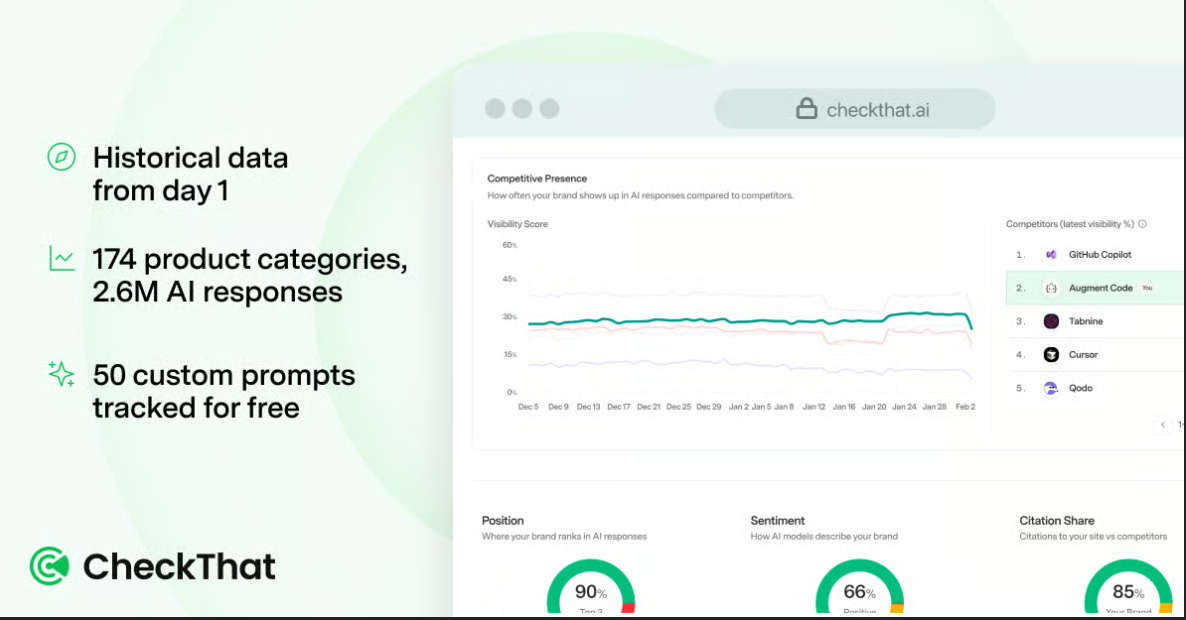
CheckThat takes a fundamentally different approach from most AEO analysis tools. Where others start with your content and ask "is this optimized?", CheckThat starts with buyer behavior and asks "what are buyers actually searching for in AI, and where do you show up?"
The platform has pre-mapped 172 B2B software categories, researched 5,800+ brands, and collected over 2.6 million AI responses across ChatGPT, Perplexity, Claude, and Google AI Mode. That means you don't start from an empty dashboard — the categories, prompts, and historical tracking data are already there when you log in.
What it checks: AI brand visibility across multiple engines, buyer-intent prompt responses (not generic keywords), historical response tracking with trend data, competitive positioning within your software category, source attribution showing where AI models pull your brand information.
Output format: Dashboard with visibility scores, prompt-level tracking, and historical trend data.
Pricing: Free public index with open data on brands and categories. Paid plans for custom prompt tracking and deeper historical access.
Best for: B2B software companies that want to understand how AI engines answer the specific prompts their buyers use — not just whether they're technically optimized.
Verdict: CheckThat's differentiator is the pre-built buyer intent layer. Most tools hand you a blank slate and say "add your prompts." CheckThat already mapped the questions that matter in your category. The trade-off is focus: it's built for B2B software specifically. If you're outside that vertical, it won't have your category pre-mapped. For B2B SaaS marketing leaders, though, this is the fastest path from "I have no idea what AI says about us" to actual intelligence.
This scrappy little tool ranks #1 for "aeo checker" despite having a domain rating of just 10. It's a free, single-purpose page checker that does one thing and does it fast.
Enter a URL, and it runs a technical scan against the AEO factors that influence whether AI engines can parse and cite your content. No brand analysis, no competitive benchmarking — just a straight technical check.
What it checks: Content structure, schema markup presence, answer-readiness formatting, basic E-E-A-T signals.
Output format: Score with a checklist-style breakdown of pass/fail factors.
Pricing: Free.
Best for: Content marketers who want a quick sanity check on a specific page before publishing.
Verdict: It's minimal, and that's a feature. When you just need to know "did I structure this page well enough for AI to cite it?", a 30-second check beats spinning up an enterprise platform. Don't expect depth — this is a smoke test, not a full diagnostic.
SE Ranking has been in the SEO game for 13+ years, and their AEO module brings AI visibility tracking into the existing platform. Currently covers Google AI Overviews and ChatGPT, with Perplexity, Gemini, Claude, and Google AI Mode planned.
What it checks: Brand mentions and links in AI responses, prompt-level visibility, competitor presence, rank position within AI answers, historical visibility changes.
Output format: Dashboard integrated into the broader SE Ranking platform.
Pricing: SE Ranking plans start at $39/month. Add-on pricing for expanded AI tracking.
Best for: Small-to-mid-size SEO teams and agencies wanting AEO and traditional SEO in one place.
Verdict: The budget-friendly option. AI engine coverage is narrower than dedicated tools (two engines vs. four or five), but the integration with existing SEO workflows avoids context-switching. Practical, not the most powerful.
→ seranking.com/answer-engine-optimization-tool
Semrush launched its AI Visibility Toolkit in September 2025, then bundled it into Semrush One. For teams already paying for Semrush, this is the path of least resistance into AEO.
What it checks: Brand visibility across AI platforms, keyword-level AI Overview tracking, citation analysis, competitor mentions, integration with existing site audit and position tracking.
Output format: Dashboard within Semrush One, AI metrics layered alongside traditional SEO data.
Pricing: Bundled into Semrush One starting at $139.95/month.
Best for: Marketing teams already using Semrush that want AEO without another tool.
Verdict: An SEO platform with AI visibility bolted on. The reporting is keyword-focused rather than prompt-focused — better at tracking Google AI Overviews than mapping ChatGPT buyer queries. Strong for consolidation, weaker for AEO-specific depth.
Maciej Turek's free AEO Lite tool is a solo practitioner's contribution to the space, and it punches above its weight. It analyzes content across six scoring categories totaling 100 points: answer readiness, schema essentials, authority signals, content quality, technical accessibility, and entity clarity.
What it checks: Question-style headers, answer paragraph length (targeting that 40–60 word sweet spot), JSON-LD schema validation, E-E-A-T indicators, breadcrumb and site hierarchy signals, entity recognition.
Output format: Score out of 100 with category breakdowns. Optional email report with a prioritized 90-day fix plan.
Pricing: Free for the basic check. Deep Scan and consulting services available at paid tiers.
Best for: SEO practitioners who want a detailed technical score with specific, actionable fixes.
Verdict: The most granular free checker we tested. Where HubSpot tells you how AI perceives your brand, AEO Lite tells you why your pages are or aren't getting cited. The scoring rubric is transparent — you can see exactly which technical factors you're missing. The upgrade path to a deep scan and consulting makes it a full funnel, from free audit to paid implementation.
→ maciejturek.com/tools/aeo-lite
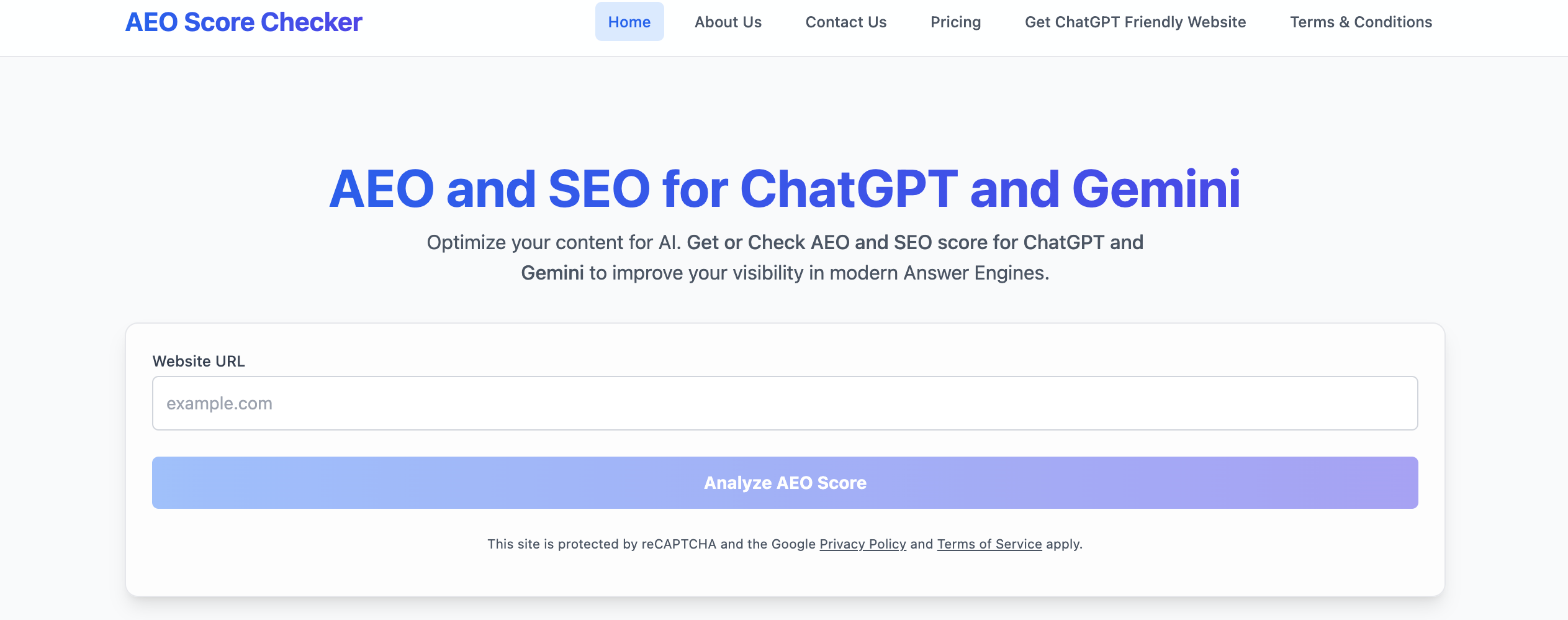
This tool is about as bare-bones as it gets. A DR 0 domain that somehow ranks on page one for "aeo checker." Enter a URL, get a score. That's it.
What it checks: Basic AEO readiness factors — content structure, schema presence, answer formatting.
Output format: Simple score.
Pricing: Free.
Best for: Someone who wants a 10-second answer to "is this page even remotely AI-ready?"
Verdict: Minimal to the point of being limited. It's a useful gut-check but won't tell you what to fix or how to improve. Think of it as a thermometer, not a diagnosis.
A standalone audit site that's earned page-one rankings despite a small backlink profile. Deeper than a simple checker, but not as complex as a full platform.
What it checks: Page-level AEO readiness, structured data validation, content format analysis, AI crawlability.
Output format: Audit report with pass/fail indicators and recommendations.
Pricing: Free tier available.
Best for: Small marketing teams running their first formal AEO audit.
Verdict: A solid middle ground. The audit report gives you enough to build a to-do list, which is exactly what most teams need at this stage.
Semai positions itself as an AEO audit report generator, producing structured outputs you can share with stakeholders or clients.
What it checks: Page-level AI readiness, content structure, schema validation, citation readiness.
Output format: Formatted audit report.
Pricing: Free audit report available.
Best for: Agencies and consultants who need a presentable audit deliverable for client engagements.
Verdict: The report format is the differentiator. If you need something stakeholder-ready without building custom decks, Semai fills that gap. Analysis depth is comparable to other free tools — the packaging is what sets it apart.
Profound sits at the enterprise end. It's built for analyst-driven teams that need high-frequency monitoring, raw data access, and revenue attribution through Google Analytics integrations.
What it checks: AI visibility at scale, citation sources, competitor benchmarking, prompt-level analysis, revenue attribution from AI search traffic.
Output format: Enterprise dashboard with API access and BI integrations.
Pricing: $99/month (Starter), $399/month (Growth), custom Enterprise.
Best for: Enterprise teams connecting AI visibility to pipeline and revenue.
Verdict: Overkill for a first audit, but powerful once you've operationalized AEO. Steeper learning curve, some users report deployment complexity. The tool you graduate to, not the tool you start with.
Otterly blends audit capabilities with ongoing monitoring — covering the gap between a one-time check and a full tracking platform. One of the most frequently cited AEO tools among practitioners.
What it checks: Multi-platform AI visibility (ChatGPT, Perplexity, Gemini, Google AI Overviews), GEO audit, prompt-level monitoring, competitive share of voice.
Output format: Dashboard with audit reports and ongoing tracking.
Pricing: $29/month (Lite, 10 prompts), $189/month (Standard, 100 prompts), $989/month (Pro, 1,000 prompts).
Best for: SEO managers and agencies wanting both initial audit and ongoing tracking in one tool.
Verdict: The bridge between auditing and monitoring. Per-prompt pricing is transparent but can get expensive at volume.
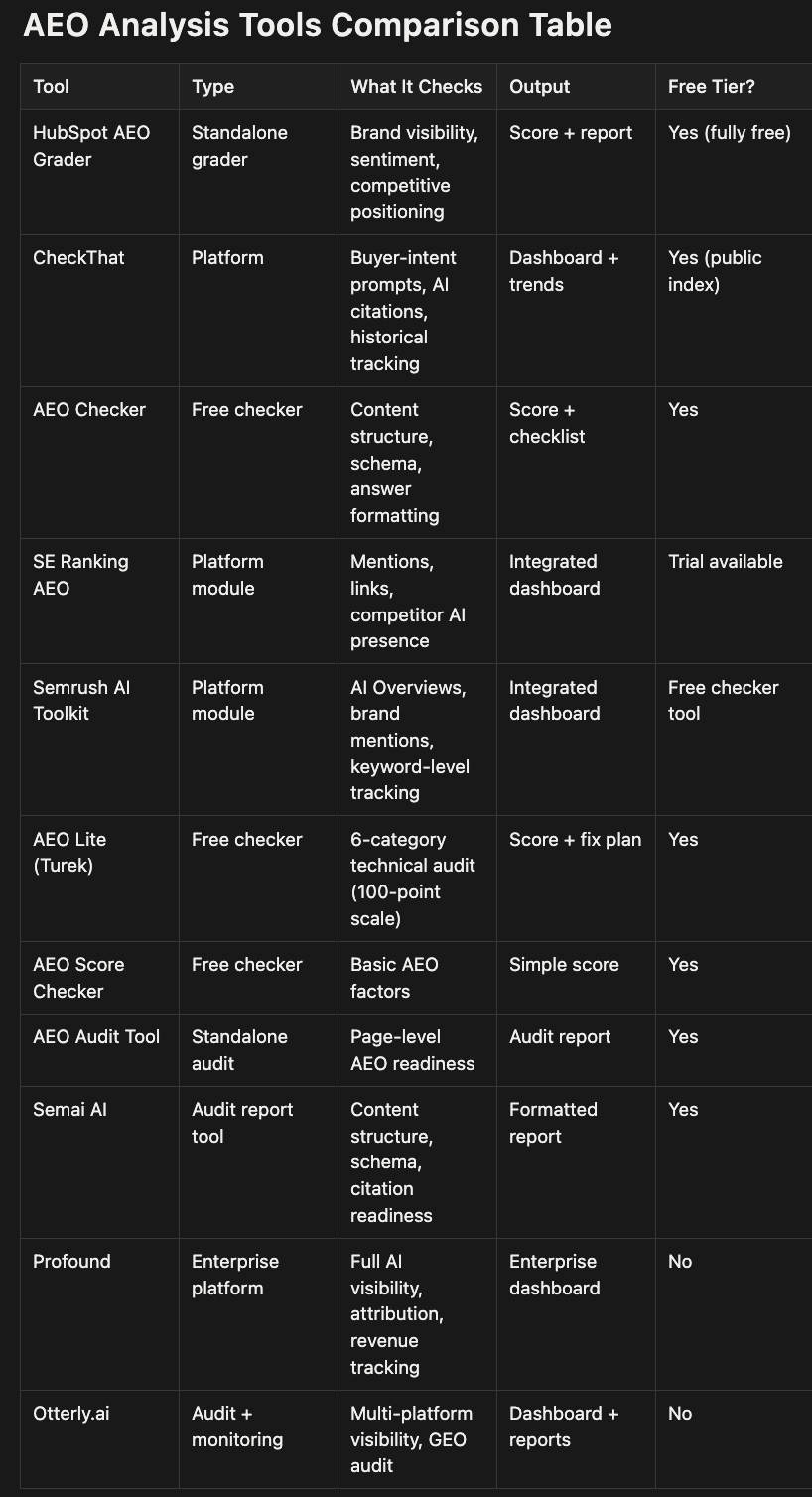
The free tools — HubSpot, AEO Checker, AEO Lite, AEO Score Checker — all deliver a useful first look. They'll tell you if something is obviously broken and give you a baseline to track against. But they won't give you competitive context, historical trends, or prompt-level tracking. They're a snapshot.
Freemium platform tools like SE Ranking and Semrush fold AEO into a broader SEO workflow. One dashboard, one subscription. The trade-off: AEO gets treated as a bolt-on, not a first-class capability.
Dedicated tools — CheckThat, Profound, Otterly — go deepest. Buyer intent mapping, prompt-level tracking, historical data, competitive benchmarking. These are for teams executing on AEO, not just exploring it.
If you're just starting: run the free tools. Get your baseline. If AI search matters to your pipeline, plan to move to a dedicated tool within a quarter.
Get a baseline score. Run your brand through HubSpot AEO Grader and your top page through AEO Lite. Brand-level and page-level scores in under ten minutes.
Check your robots.txt. Open yoursite.com/robots.txt and look for blocks on GPTBot, ClaudeBot, or PerplexityBot. If those bots are disallowed, nothing else matters — you're invisible to AI crawlers.
Audit your schema markup. Use Google's Rich Results Test or the schema checks in AEO Lite to verify FAQ, HowTo, and Article structured data. Missing schema is one of the easiest AEO wins.
Test your AI visibility manually. Open ChatGPT, Perplexity, and Google AI Overviews. Search for your brand, your product category, and a few buyer-intent questions. Are you showing up? Fifteen minutes of manual testing often reveals more than any automated tool.
Run a deeper analysis. Use CheckThat, SE Ranking, or Semrush for competitive context and prompt-level data. Move from "how do I score?" to "what should I do about it?"
Set up ongoing monitoring. An audit is a starting point. Transition to ongoing tracking with a tool from our AI search visibility tools guide.
Auditing is step one. You can't optimize what you haven't measured, and you can't justify investment in AEO without a baseline to track against.
Now that you know where you stand, two paths forward: check out our complete guide to AEO. And when you're ready to move from point-in-time audits to ongoing measurement, our AI search visibility tools guide covers the tracking and monitoring layer.
If you want to skip straight to buyer-intent AI visibility for your B2B software brand, try CheckThat — the pre-built category research and prompt library means you'll have answers before most teams figure out which questions to ask.
Every week, we share real examples and systems the fastest-growing companies are using to scale smarter.
Get the last workshop recording when you sign up.
A practical guide to why AI search monitoring tools belong in a growth stack — covering automation, competitive intelligence, intent tracking, local visibility, and revenue attribution.

A practical guide to nine tools that store and supply brand context to AI systems — from marketing writing assistants to enterprise search platforms.

Compare ten AI visibility tracking tools by engine coverage, prompt methodology, pricing transparency, workflow fit, and the actions each tool supports.